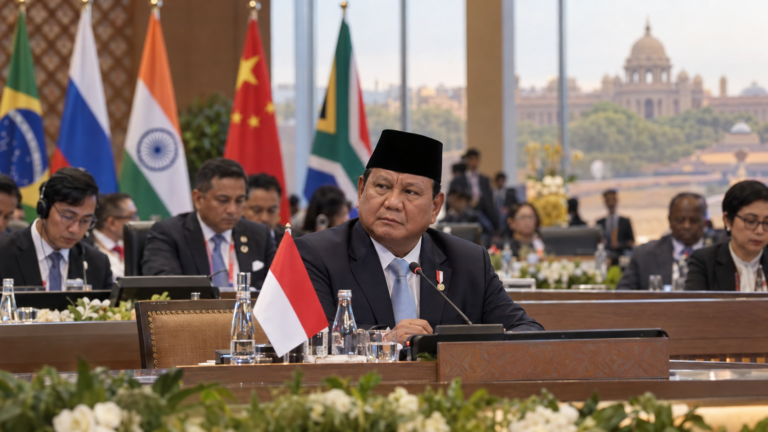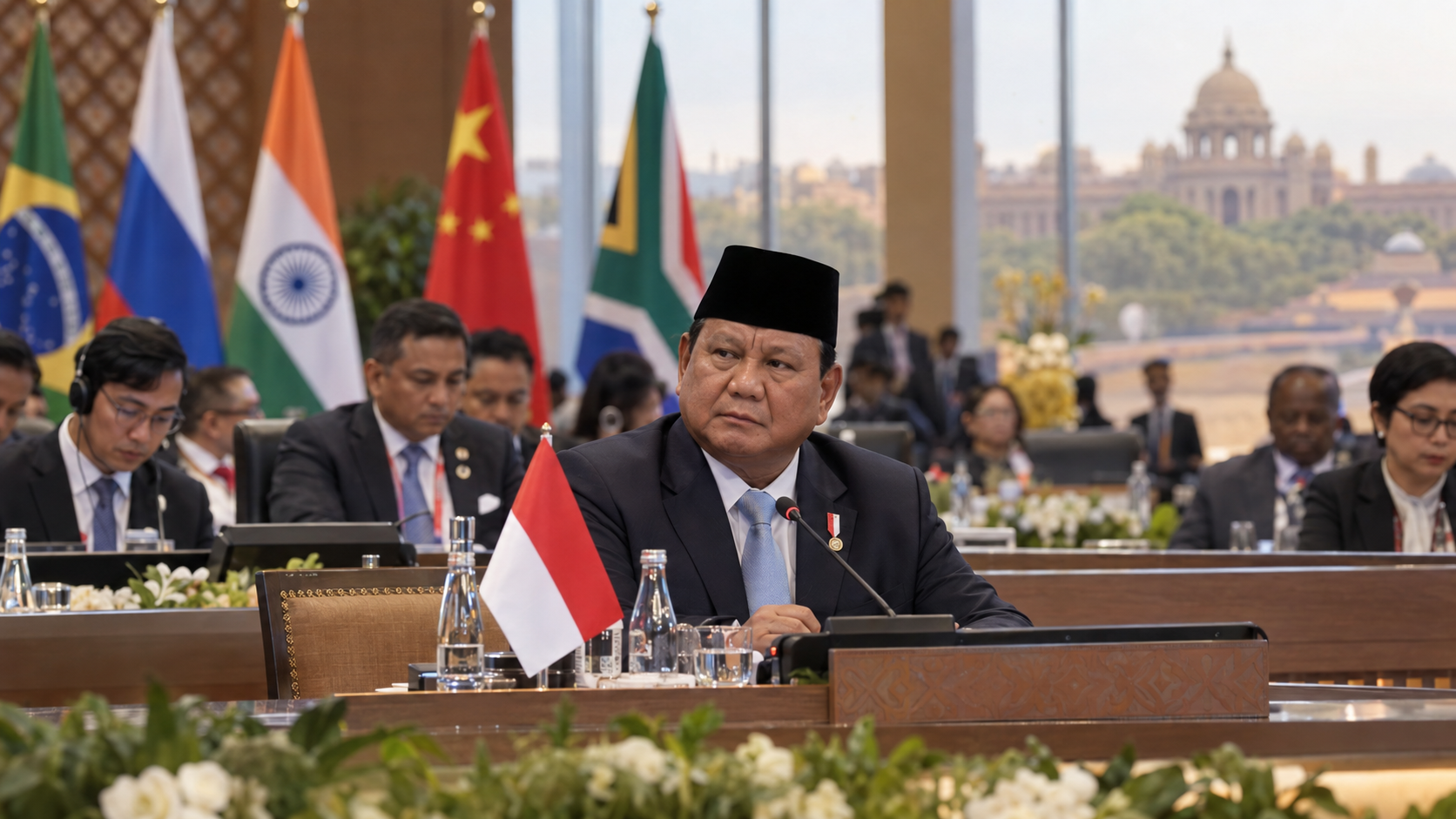
At the 2026 BRICS Summit in New Delhi, President Prabowo Subianto presented proposals on industrialisation, economic resilience and global governance reform. His message reflected Indonesia’s ambition to help developing countries gain greater influence over international decision-making.
The summit took place on September 12–13 under India’s presidency. Leaders adopted the New Delhi Declaration, covering trade, finance, technology, climate resilience and reform of institutions such as the United Nations and World Trade Organization.
Indonesia joined BRICS as a full member in January 2025. It remains the organisation’s only full member from Southeast Asia, while Malaysia, Thailand and Vietnam participate as partner countries.
Indonesia’s priorities at the BRICS Summit
Prabowo brought three main messages to the closed leaders’ meeting. He called for greater national resilience, stronger unity among Global South countries and more practical cooperation within BRICS.
The president connected national resilience with the ability to meet essential public needs. He identified food, energy and education as foundations for an independent development strategy.
Prabowo also argued that BRICS needed to turn its demographic and economic strength into practical opportunities. Cooperation should connect developing countries with markets, investment, technology and expertise.
Independence and the Bandung spirit
Prabowo invoked the spirit of the 1955 Asian-African Conference in Bandung. The reference carried particular weight because Indonesia’s modern identity emerged from a long struggle for independence and freedom from colonial rule.
After proclaiming independence in 1945, Indonesia defended its right to determine its own political future. Ten years later, the Bandung Conference brought together Asian and African countries, many of which had only recently achieved independence or were still resisting colonial control.
Indonesia helped create a platform where these countries could defend sovereignty, equality, peaceful coexistence and national self-determination. Bandung demonstrated that states outside the established centres of power could organise around their own priorities.
Prabowo’s appeal to solidarity connected Indonesia’s independence story with a modern argument: developing nations should not remain passive recipients of decisions made by more powerful countries.
Indonesia is now a large democracy whose foreign policy continues to follow the principle of bebas aktif, or free and active. That position rejects automatic alignment with any major power while encouraging active involvement in international affairs.
BRICS gives Indonesia another platform to practice that approach. However, Jakarta must ensure that Global South solidarity protects the independence of developing countries rather than replacing one form of external dependence with another.
From resources to industrial strength
During the summit’s open session, Prabowo proposed stronger cooperation on industrialisation and global supply chains. He argued that BRICS countries already possessed many of the resources, markets and production capabilities needed to build an integrated economic network.
Indonesia played an important role in that discussion. It holds major reserves of nickel and other critical minerals. It also has extensive forests, renewable-energy potential and a large domestic market.
Prabowo urged members to connect these advantages with capital and technology. The goal was to create jobs and retain more value inside developing economies rather than exporting resources with limited domestic processing.
The New Delhi Declaration broadly supported that approach. It called for developing countries to enter higher-value areas of global manufacturing. It also promoted technology transfers, resilient supply chains and greater use of national currencies in trade.
About the Author