Ancient cave paintings
Some of the world’s oldest known cave paintings have survived for tens of thousands of years in Indonesia. Now, wildfires, climate change and industrial activity are raising concerns about their future. These prehistoric artworks offer rare glimpses into humanity’s earliest creativity, making their preservation a matter of global importance.
Wildfires approach ancient archaeological sites
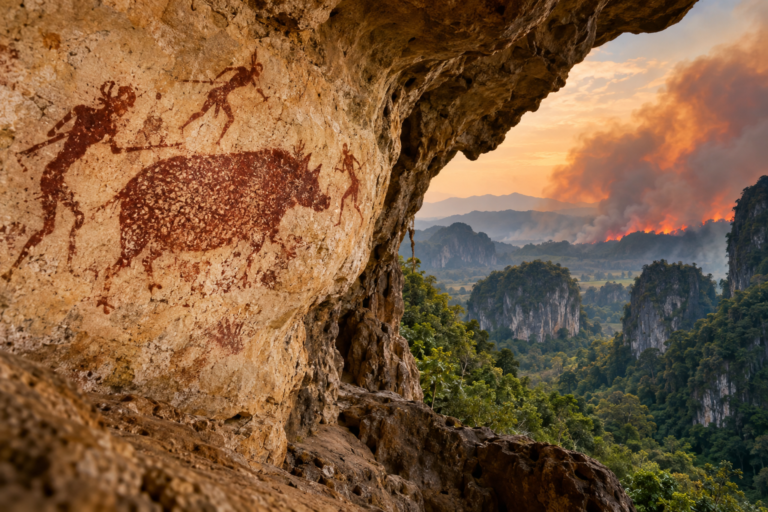
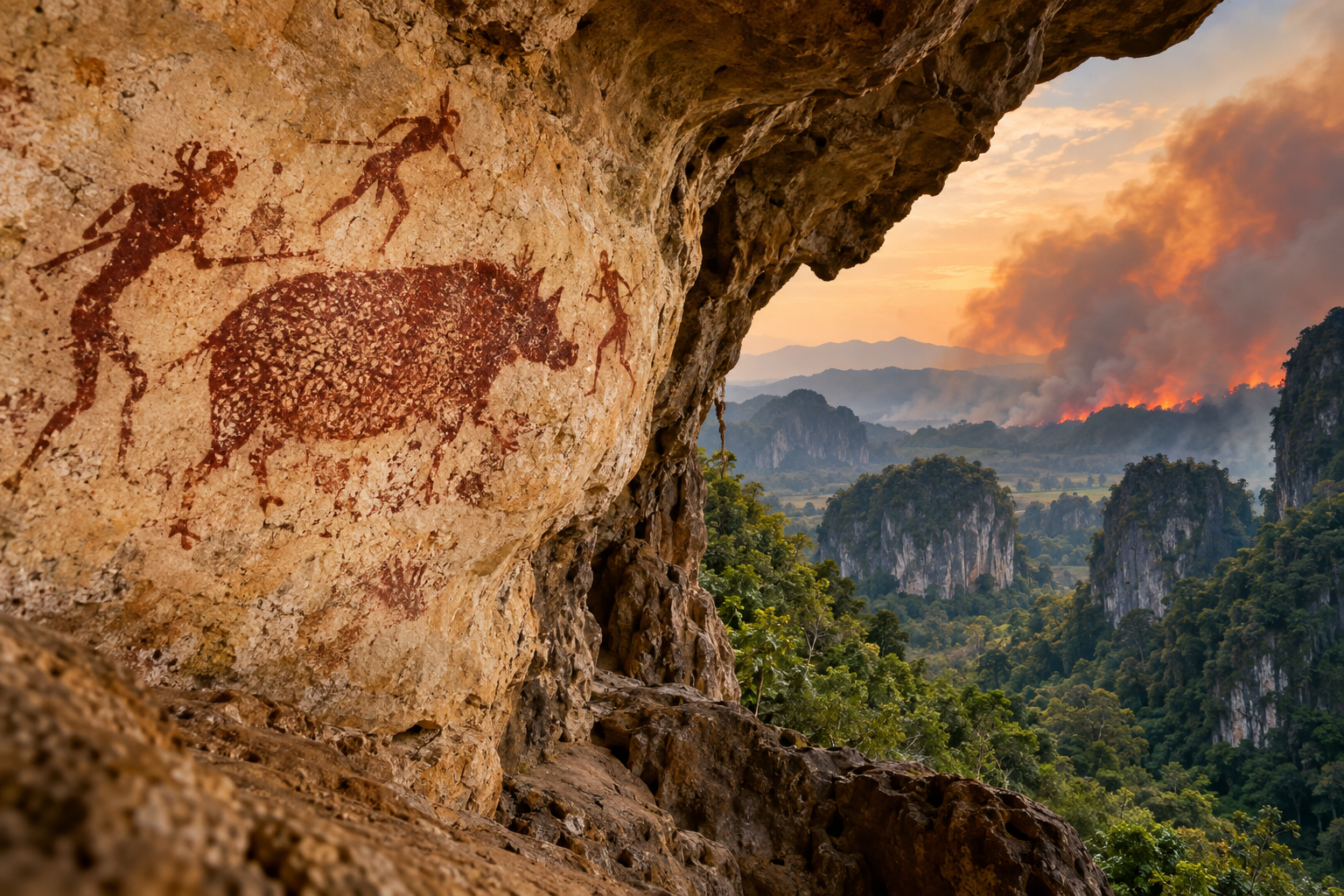
In October 2026, wildfires swept through parts of South Sulawesi, threatening the limestone caves of Maros-Pangkep, home to some of the earliest known examples of human art.
Between September 30 and October 18, fires burned more than 270 hectares of Bantimurung Bulusaraung National Park. At one point, flames came within approximately 800 metres of an important cave site.
The danger extends beyond direct contact with fire
The fires come amid severe drought and exceptionally dry conditions associated with El Niño, which have affected several Indonesian regions. Researchers warn that intense heat can accelerate the deterioration of ancient pigments and limestone surfaces. Smoke can also deposit soot, making paintings harder to distinguish.
There is no confirmation that the recent fires have destroyed the famous paintings. Nevertheless, researchers warn that without effective protection, irreplaceable archaeological evidence could be lost.
Discoveries that changed our understanding of human history
Indonesia has become central to scientific research into the origins of art and storytelling. In 2024, researchers announced that a cave painting at Leang Karampuang, South Sulawesi, was at least 51,200 years old. The artwork depicts three human-like figures interacting with a wild pig. Scientists consider it the earliest securely dated surviving example of a narrative scene in visual art.
Then, in January 2026, another remarkable discovery pushed the timeline even further back. At Liang Metanduno cave on Muna Island, Southeast Sulawesi, archaeologists identified a hand stencil dating to at least 67,800 years ago. It is currently considered the oldest securely dated rock art known.
These dates represent minimum ages established through scientific analysis of mineral deposits covering the paintings. The artworks themselves may be older.
These findings challenge the traditional emphasis on European prehistoric art. They also provide important evidence about early human populations moving through Southeast Asia toward Australia and New Guinea.
Beyond wildfires: A slower threat to cave paintings
Scientists have warned about the deterioration of Sulawesi’s prehistoric art for years. A 2021 study published in Scientific Reports examined paintings at 11 archaeological sites in Maros-Pangkep. Researchers identified salt crystallisation, or haloclasty, as a major cause of deterioration.
When moisture evaporates, salt crystals can form within limestone surfaces. As they expand, sections of rock may crack and flake away, taking ancient pigments with them. Higher temperatures, prolonged dry periods and changes in moisture conditions can accelerate this process.
Researchers observed substantial deterioration over recent decades, suggesting that climate change could make preservation increasingly difficult.
Industrial development adds another challenge
Environmental changes are not the only concern. In February 2025, Indonesia’s Culture Minister Fadli Zon raised concerns about limestone extraction and cement production near prehistoric archaeological sites in Maros-Pangkep. He said the government had contacted local authorities over industrial activities near the heritage area. The minister also highlighted the need to control visitor access and prevent tourists from touching fragile paintings.
Limestone extraction supports construction and economic development, but poorly managed operations near archaeological sites can create conservation risks. This highlights a broader challenge for Indonesia: balancing economic development with the protection of irreplaceable cultural heritage.
Protecting a heritage of global importance
In 2023, Maros-Pangkep received UNESCO Global Geopark recognition, acknowledging its extraordinary geological features and prehistoric heritage. The geopark contains hundreds of caves, distinctive limestone formations and numerous archaeological discoveries.
However, UNESCO Global Geopark recognition does not automatically provide the same protections as UNESCO World Heritage status. Conservation work also involves Indonesian researchers, cultural heritage authorities and international scientific institutions.
Stronger wildfire prevention, careful monitoring of cave conditions, responsible tourism and restrictions on harmful activities near sensitive sites could help protect these treasures.
The recent fires underline how vulnerable even humanity’s oldest surviving artistic achievements can be.
The paintings have endured enormous environmental changes over tens of thousands of years. Yet their future may now depend on conservation decisions made within the next few decades.
Protecting them is not simply about preserving Indonesia’s past. It is about safeguarding a part of humanity’s shared history that, once destroyed, cannot be recovered.
About the Author