Prabowo North and South Korea
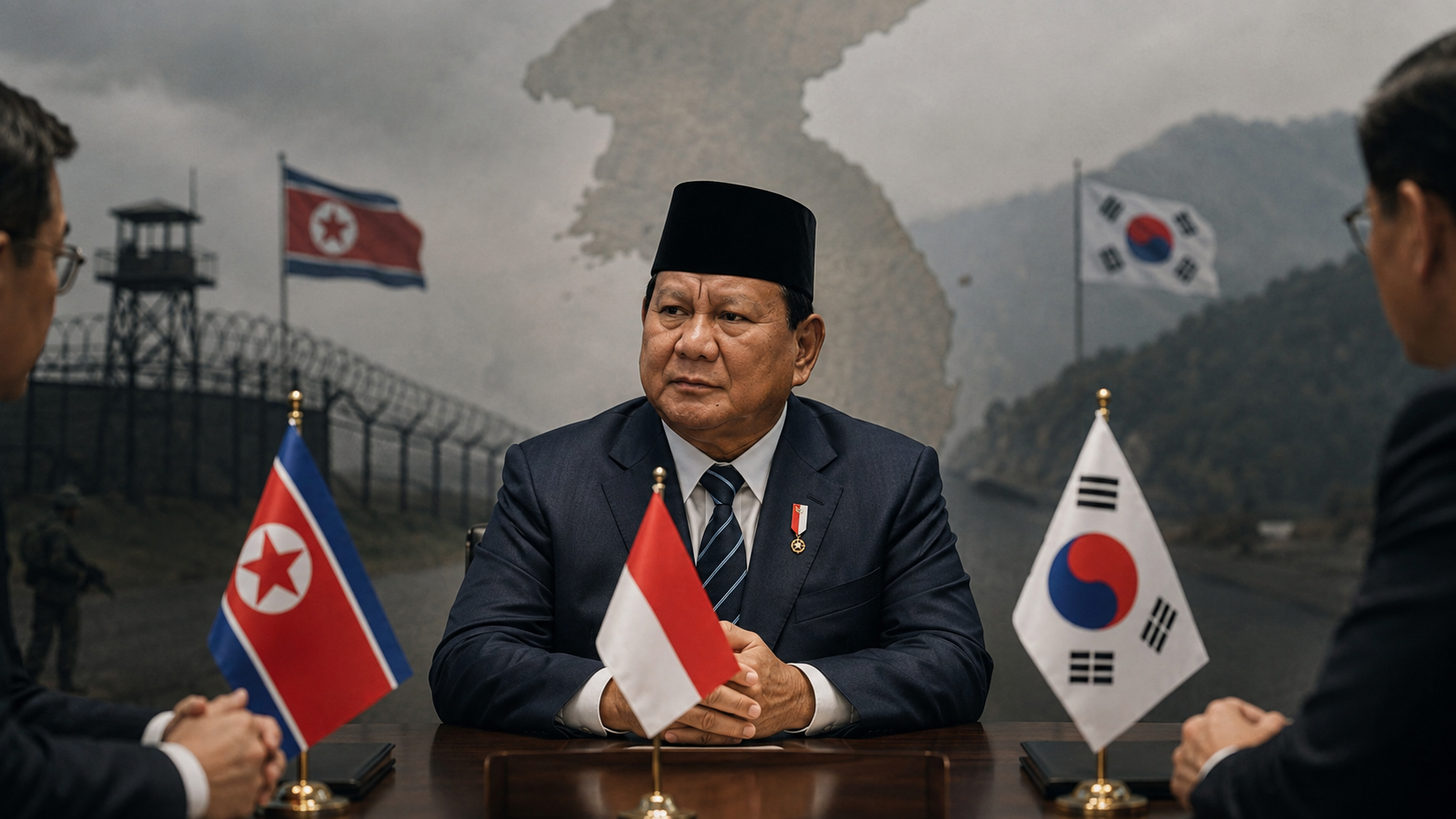
President Prabowo Subianto says he is willing to visit North Korea and help open dialogue with South Korea. Indonesia has something few countries possess: diplomatic access to Pyongyang, a substantial partnership with Seoul and a long tradition of non-aligned diplomacy.
The question is whether those advantages can make Indonesia a genuine mediator, or mainly a useful messenger between two governments that increasingly regard each other as enemies.
South Korea turns to Prabowo
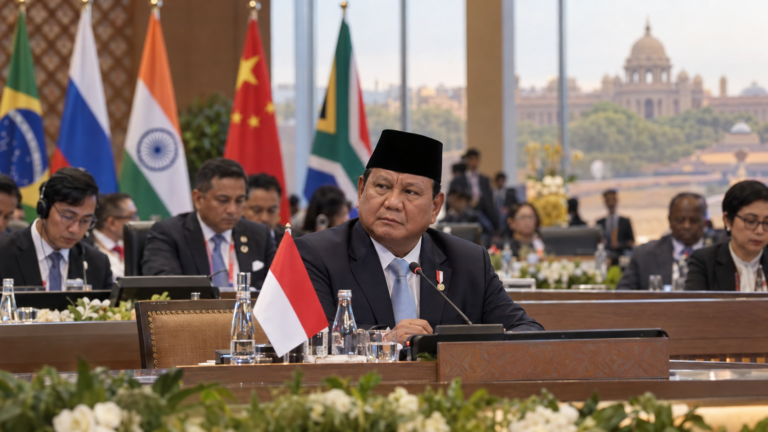
Prabowo said South Korean President Lee Jae Myung raised the idea during his visit to Seoul in April. According to Prabowo, Lee asked whether he could visit North Korea and help open communication.
Prabowo accepted in principle, arguing that Indonesia is trusted because it does not interfere in other countries’ domestic affairs.
Lee has tried to reduce tensions since taking office. North Korea, however, has rejected Seoul’s overtures and formally described South Korea as a “hostile state.”
A war that never formally ended
The division of Korea dates to the aftermath of the Second World War. War erupted in 1950 after North Korea invaded the South, drawing in United Nations forces led by the United States and Chinese forces supporting the North.
The fighting ended with an armistice in 1953, not a peace treaty. The two sides therefore remain technically at war, separated by the Demilitarized Zone, or DMZ, one of the world’s most heavily fortified borders.
Recent events show how easily symbolic confrontation can become a security crisis. In 2024, North Korea sent thousands of balloons carrying rubbish into the South. Pyongyang called this retaliation for South Korean activists sending anti-North Korean leaflets and media across the border. Seoul responded by restarting loudspeaker broadcasts carrying news, criticism of the regime and South Korean music.
North Korean troops were also seen laying mines, erecting barriers and clearing land inside the DMZ. Some soldiers accidentally crossed the military demarcation line, prompting South Korean warning shots. Landmine explosions reportedly caused casualties among the North Korean workers.
Behind these border incidents lies the larger danger of North Korea’s expanding nuclear arsenal and ballistic-missile programme. Pyongyang says its nuclear status is irreversible, while its missiles are designed to threaten South Korea, Japan and potentially the United States.
Indonesia’s unusual history with North Korea
Indonesia’s possible role rests partly on a relationship dating back to the Sukarno era.
Sukarno and North Korean founder Kim Il Sung developed a personal friendship as leaders of postcolonial countries associated with the Non-Aligned Movement. During Kim’s 1965 visit, Sukarno took him to the Bogor Botanical Gardens. An orchid cultivar was later named Kimilsungia in his honour.
Decades later, Sukarno’s daughter Megawati Sukarnoputri visited Pyongyang as president in 2002 and met Kim Jong Il. She then travelled to Seoul carrying a message from the North Korean leader. The episode demonstrated that Jakarta could communicate with both governments.
Much closer to South Korea today
Indonesia is not equally close to the two Koreas. Its ties with North Korea are mainly historical and diplomatic. Its partnership with South Korea involves trade, investment, technology, energy and defence production, including cooperation on the KF-21 fighter programme.
Pyongyang may therefore see Indonesia as more acceptable than the United States or Japan, but not necessarily as completely neutral.
Access is not leverage
Prabowo’s offer fits his broader effort to give Indonesia a larger diplomatic role. Indonesia can host talks, carry messages and reopen channels when direct communication has broken down.
But access is not the same as leverage. Jakarta cannot lift international sanctions, guarantee North Korea’s security or determine the future of US forces in South Korea. It cannot force Pyongyang to negotiate over weapons that the regime considers essential to its survival.
Prabowo may be able to open a door between the two Koreas. Whether North Korea chooses to walk through it remains another matter.
About the Author