Fertility Rate
Indonesia just turned 81, and it’s holding onto something most nations have already lost: a young population. Across much of the world, countries are shrinking. Fewer babies are born each year, and the population that remains is getting older, fast. Indonesia isn’t immune to that shift, but it’s arriving late, and that timing gives the country something increasingly rare: room to prepare.
A World Running Out of Babies
Demographers use one number to track this: the total fertility rate, or the average number of children a woman has in her lifetime. A country needs roughly 2.1 children per woman just to keep its population stable over time. Fall below that for long enough, and the population eventually shrinks and ages.
That shift carries real economic weight. Fewer young workers means a smaller tax base and labor force just as a growing share of retirees draws on pensions and healthcare systems. Fewer workers per retiree strains both. Consumer spending softens, since older populations typically spend less than younger, family-forming ones. And the labor shortages already visible in Japan and parts of Europe tend to compound over time, since a shrinking generation of workers produces an even smaller next generation. Left unaddressed, the result is slower growth and heavier fiscal pressure precisely when a country can least afford either.
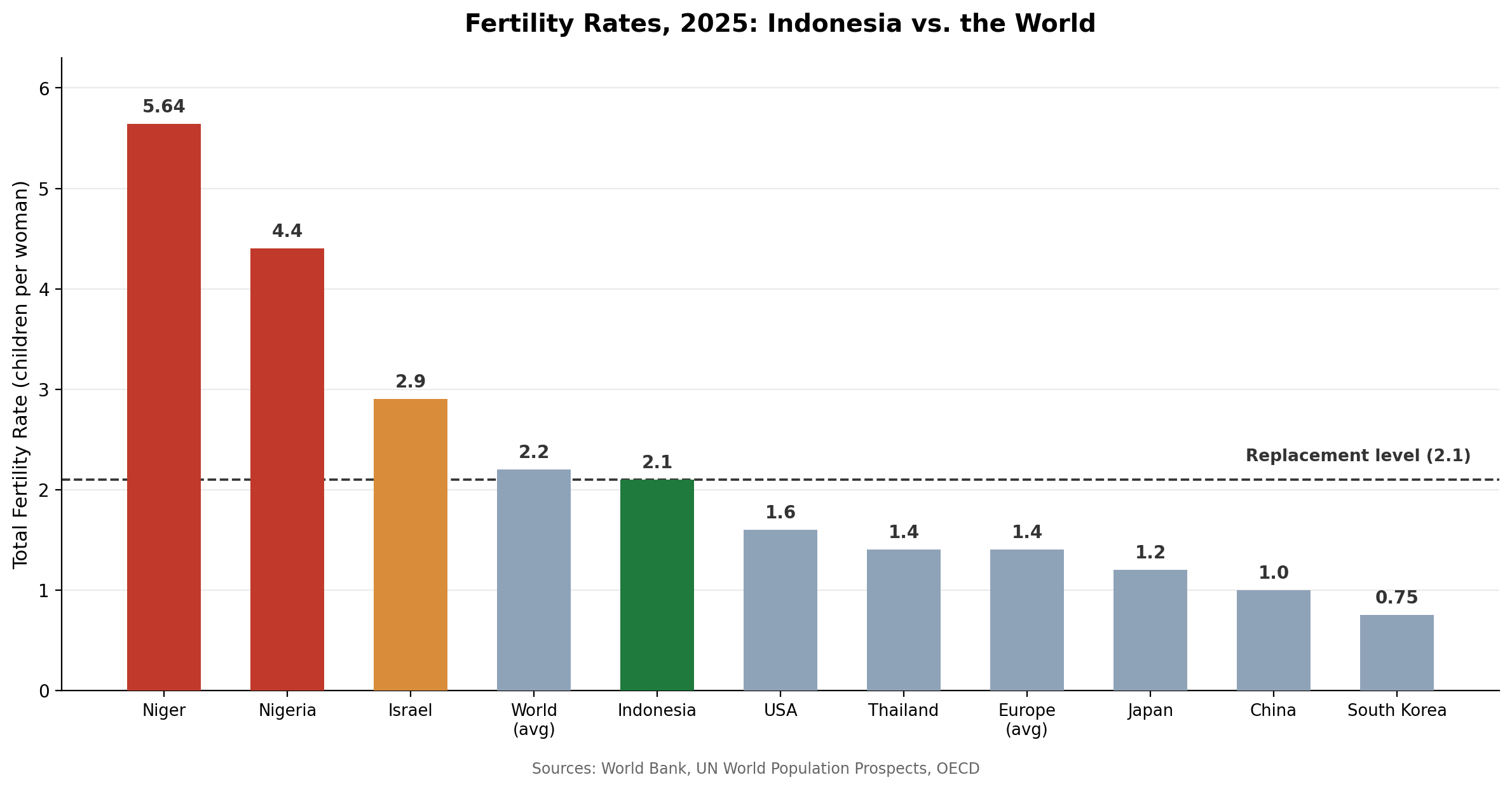
More than half the world’s countries are already below replacement level. The extremes on either side are stark.
The Lowest Rates
East Asia anchors the bottom of the global rankings. South Korea’s fertility rate sits near 0.75, the lowest of any major economy on Earth, with Hong Kong and China close behind at around 1.0. Japan follows at roughly 1.2. Europe as a whole averages around 1.4, and even the United States, long considered an outlier among wealthy nations, has slipped to about 1.6.
There are exceptions worth noting. Israel stands out at roughly 2.9, the only developed economy still above replacement level. France, at around 1.8, holds the highest rate among major European nations, still short of 2.1, but well ahead of its neighbors.
The Highest Rates
The opposite extreme clusters almost entirely in Sub-Saharan Africa. Niger and Chad both sit above 5.6 children per woman, with Somalia and the Democratic Republic of Congo close behind. In fact, 18 of the world’s 20 highest-fertility countries are found in the region; Afghanistan is one of the rare exceptions elsewhere. Nigeria, the region’s most populous nation, still averages around 4.4, and Pakistan, another demographic heavyweight, sits near 3.4, both well above replacement level.
Where Indonesia Stands
Indonesia sits right at the edge, not high-fertility like it was a generation ago, but not in East Asia’s danger zone either. According to World Bank data, the rate has fallen steadily from over 5 children per woman in the 1970s to roughly 2.1 today, essentially replacement level. The population, now around 288 million people, is still growing, by roughly 0.8% a year.
The bigger story is the age structure. About 70% of Indonesians are of working age (15 to 64), while only 6% are 65 or older. Compare that to Japan, where nearly 3 in 10 people have already passed 65. Indonesia’s median age is around 30. Japan’s is closer to 49.
| Country / Region | Fertility Rate (2025) |
|---|---|
| Niger | ~5.6 |
| Nigeria | ~4.4 |
| Pakistan | ~3.4 |
| Israel | ~2.9 |
| World average | ~2.2 |
| Indonesia | ~2.1 |
| France | ~1.8 |
| United States | ~1.6 |
| Thailand | ~1.4 |
| Europe (average) | ~1.4 |
| Japan | ~1.2 |
| China | ~1.0 |
| South Korea | ~0.75 |
The Window That’s Still Open
Economists call this a demographic dividend: a stretch where the working-age share of the population peaks relative to children and retirees. It’s a rare, historically favorable setup, and Indonesia is living through it right now. Most projections put the window open through the early-to-mid 2030s, which gives the country a genuine, if limited, runway to convert a young population into sustained economic growth.
That’s a very different position from its neighbors. Thailand’s population is aging quickly despite its smaller size, and China spent decades with a similar dividend but largely used it up before its fertility collapse hit. Indonesia is watching that story unfold next door and still has time to write a different ending.
Not a Free Pass
None of this happens automatically. A dividend only pays off if there are enough jobs, skills training, and infrastructure to absorb a large working-age population. And Indonesia’s own fertility rate is falling too, just about 15 to 20 years behind the countries now grappling with the fallout. The same forces reshaping fertility in China, Japan, and South Korea, urbanization, rising education, more women in the workforce, are already at work in Indonesia. The window won’t stay open forever.
A Generation’s Task
When Indonesia declared independence in 1945, the challenge was building a nation from scratch. Today’s challenge is different but just as consequential: making the most of a demographic window that many of its neighbors have already watched close. The UN’s population projections make clear how unusual this moment is globally. Not every country gets a second chance to plan ahead. Indonesia, for now, still does.
About the Author