Artificial intelligence is no longer a distant possibility for Indonesian healthcare. It is already being tested in tuberculosis screening, pregnancy monitoring and cervical-cancer detection. AI-assisted systems are also beginning to appear inside hospitals.
These tools could be particularly valuable in an archipelago where specialists and advanced equipment remain concentrated in major cities. Many Indonesians rely on government-run community health centers, known as puskesmas, and smaller facilities with limited resources. AI could help health workers examine images, organize records and identify patients who require urgent attention.
The stakes, however, are high. An inaccurate prediction involving tuberculosis, cancer or pregnancy can have serious consequences. Indonesia must therefore expand useful technology without allowing ambition to move faster than patient protection.
Faster tuberculosis screening
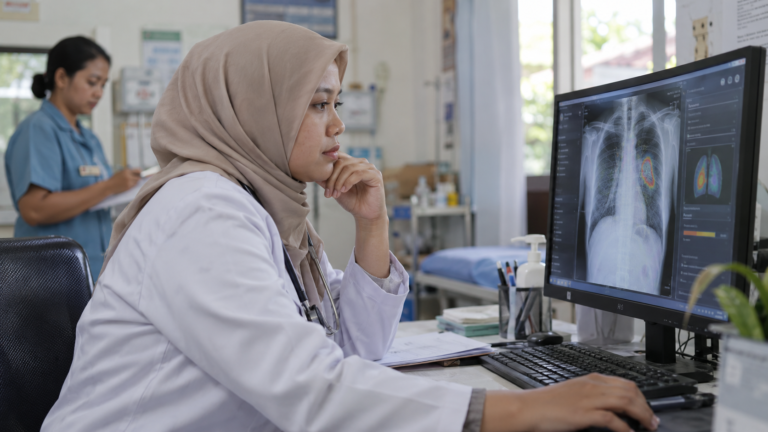
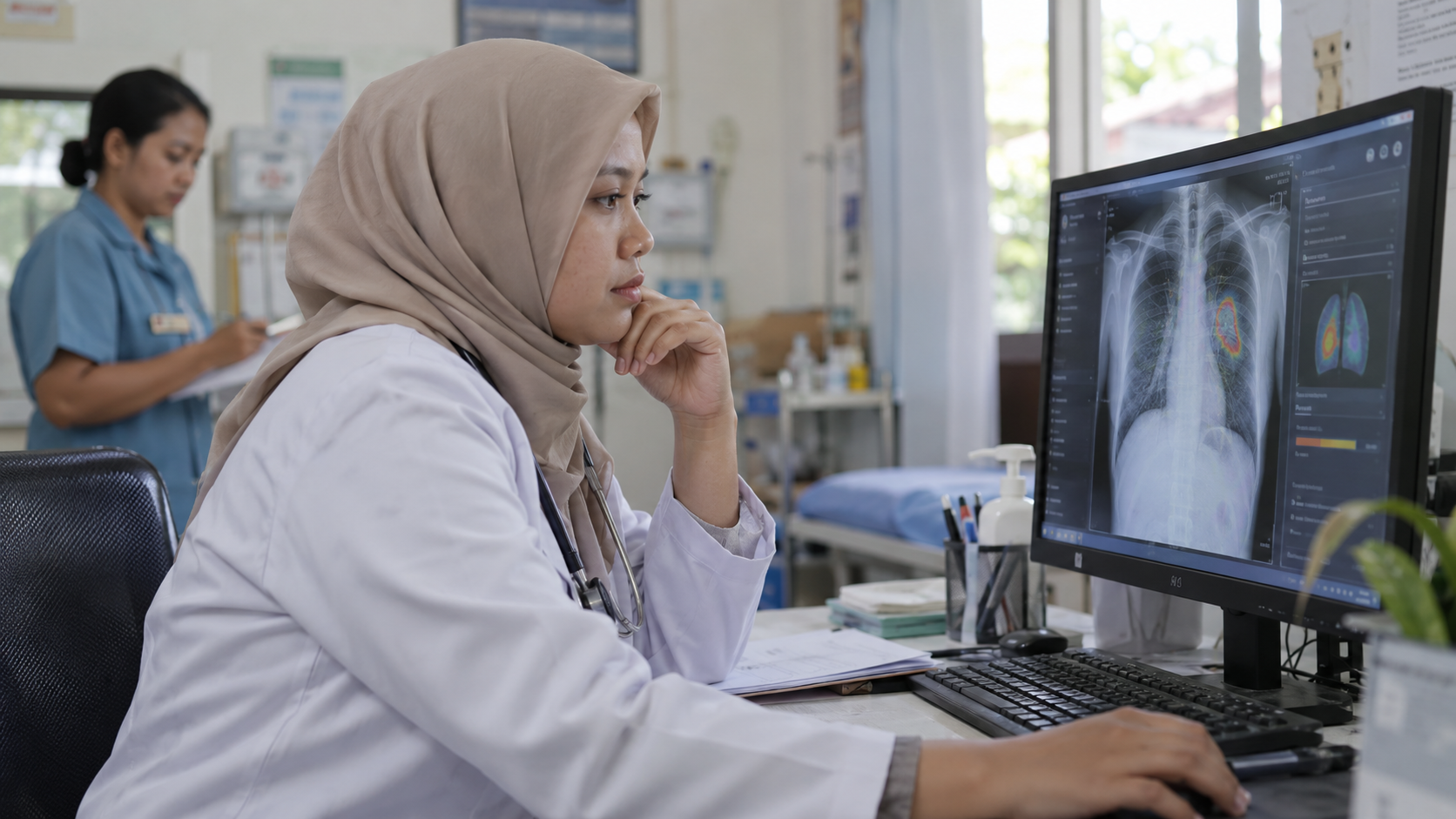
One of Indonesia’s clearest uses for healthcare AI involves tuberculosis. The Ministry of Health has combined chest X-rays with AI-assisted analysis to identify abnormalities that may indicate the disease.
Indonesia has the world’s second-highest tuberculosis burden. Undetected infections allow the disease to spread and delay treatment, while many areas lack sufficient access to radiologists.
TBScreen.AI, an Indonesian initiative supported through the Australia-Indonesia KONEKSI partnership, is developing technology that can analyse a chest X-ray in less than five minutes. It could help health workers prioritise suspicious cases in areas where specialist assessment is not immediately available.
The software does not provide a final diagnosis. Medical evaluation and further testing remain necessary before treatment begins.
From paper records to earlier intervention
Another project is testing AI in maternal and child healthcare across Lombok and Garut. It involves the Summit Institute for Development, BRIN, Mataram University and Australia’s CSIRO.
The project connects three tools. Bunda OCR converts handwritten information from the Buku KIA maternal and child health handbook into structured data. A predictive dashboard helps workers identify pregnancies that may need closer monitoring. Personalised WhatsApp messages then provide relevant information to pregnant women.
This could turn information stored in paper booklets into early warnings and more targeted follow-ups. However, the tools remain under development. Published reports have not yet shown that they reduce maternal deaths or improve pregnancy outcomes.
Researchers at Sriwijaya University are pursuing a similar goal with TeleOTIVA. The system uses AI-assisted image analysis to support cervical precancer screening. Nurses and midwives could capture images during examinations and connect patients with specialist assessment, potentially extending screening beyond large hospitals.
In September, Sriwijaya University and Leiden University Medical Centre discussed further clinical validation. TeleOTIVA has already undergone evaluation in Indonesia, but broader testing is still needed across different populations and clinical settings.
AI enters Indonesian hospitals
AI is also beginning to support doctors inside private hospitals. Mandaya Royal Hospital Puri recently introduced an AI-assisted medical information system that helps physicians retrieve and evaluate clinical evidence.
Such tools could save time when doctors review complicated cases. Other applications may support radiology, surgery, hospital administration and drug development. Nevertheless, final clinical responsibility must remain with qualified professionals. A confident AI-generated answer can still be incomplete or wrong.
New rules for higher-risk technology
On September 7, the Ministry of Health issued Decree No. HK.01.07/MENKES/951/2026. It establishes approval guidelines for independent medical software, software built into physical devices and products incorporating AI.
Developers must provide clinical evidence concerning safety, accuracy and performance. They must also consider whether their data represent intended patients and check whether the system performs differently across particular groups.
Certain imported products may require local clinical validation. This applies especially to medium- and high-risk AI used for diagnosis, screening or clinical decisions. A system trained mainly on foreign hospital data cannot simply be assumed to work equally well with Indonesian patients.
The rules also cover cybersecurity, patient consent, data retention and the reporting of security breaches. Developers must monitor products after they enter the market, while updates and model retraining are subject to controls.
Medical software should also be compatible with SATUSEHAT, Indonesia’s national health-information platform. This could improve continuity of care and prevent the creation of more disconnected hospital systems.
What regulation cannot solve
The decree is an important step, but enforcement will determine its value. Regulators need the expertise to examine datasets, assess clinical evidence and monitor AI systems that can change after deployment.
There are also practical limits. Poor handwriting, incomplete records and unrepresentative data can produce unreliable results. Smaller facilities may lack stable internet connections, suitable equipment or workers trained to use new systems. Technology cannot create a functioning clinic, supply emergency transport or replace missing medical personnel.
Indonesia should judge healthcare AI by measurable outcomes: earlier diagnosis, safer treatment, lower administrative workloads and wider access to care. The number of applications launched or seminars held means little if patients see no improvement.
AI could become a valuable part of Indonesian healthcare. But it should strengthen health workers rather than replace their judgement, and it must not distract from investment in clinics, personnel and essential services.
About the Author