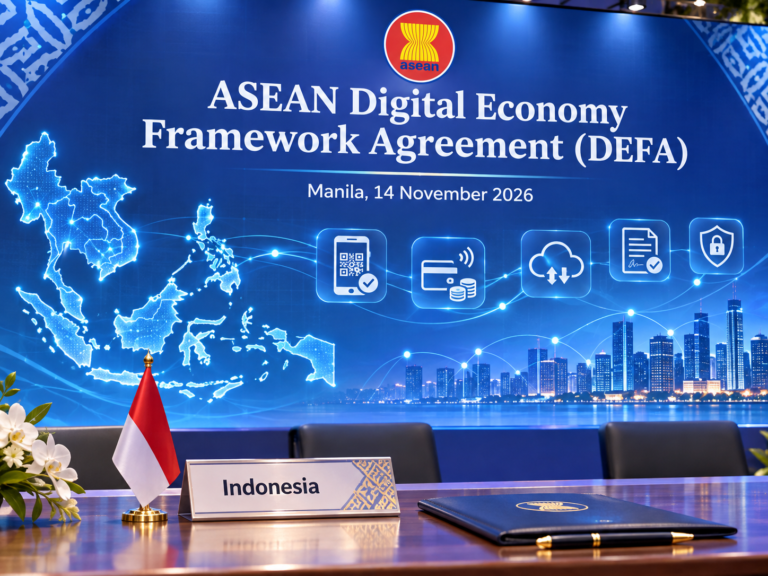
President Donald Trump’s administration announced proposed tariffs on China, Indonesia and 12 other major trading partners on November 25, accusing them of manufacturing practices that distort international competition. The decision has renewed scrutiny of China’s industrial subsidies and excess production, raising questions about whether other economies are also paying the price for Beijing’s policies.
Washington proposed tariffs of up to 20% on Chinese goods and 18% on Indonesian products, subject to exemptions and existing duties. Malaysia, Thailand, Vietnam, Japan, South Korea and the European Union are also among those targeted.
The measures have not yet taken effect.
How China’s industrial policies distort competition
For decades, China has supported strategic industries through subsidies, preferential loans, tax incentives and state-directed investment.
Government assistance is not inherently unfair. However, problems arise when companies receive support that allows them to expand production beyond commercial demand or remain operational despite persistent losses. Such manufacturers can sell goods at prices that competitors operating under normal market conditions struggle to match.
Over time, this can force foreign competitors to scale back production or shut down altogether, allowing Chinese manufacturers to capture larger shares of international markets. Critics warn that such practices risk weakening entire industries abroad and leaving other economies increasingly dependent on Chinese suppliers.
The consequences extend beyond individual businesses. Artificially supported production can depress global prices, discourage investment elsewhere and threaten manufacturing jobs.
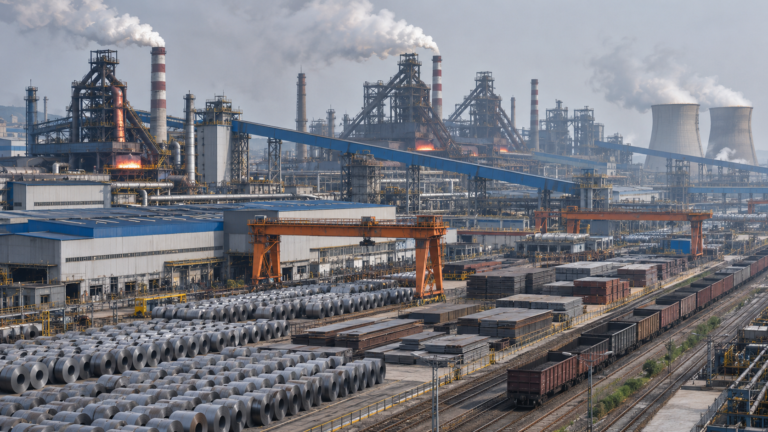
China’s steel industry exposes the scale of industrial overcapacity
According to the OECD’s 2026 Steel Outlook, the typical Chinese steel company received 15 times more subsidies relative to its assets than comparable producers elsewhere in 2024. This support includes government grants, tax concessions and loans offered below market rates.
China also accounted for approximately 54% of the global gap between steel production capacity and demand in the third quarter of 2025. Weak domestic demand has encouraged Chinese producers to export more steel, increasing pressure on manufacturers abroad.
Beyond steel: China’s industrial overcapacity extends to other sectors
China’s rapid expansion in the electric vehicles, batteries and solar panels industries has contributed to international price pressures and raised concerns about industrial overcapacity. The European Union, for example, introduced additional duties on Chinese electric vehicles following an investigation into government subsidies.
While Chinese technological advances and economies of scale also help explain Chinese manufacturers’ competitiveness, extensive state support raises questions about whether foreign manufacturers can compete on equal terms.
Indonesia’s steel industry faces growing Chinese competition
The consequences of Chinese industrial expansion are already visible in Indonesia.
In September 2026, Indonesia’s Anti-Dumping Committee (KADI) launched an investigation into galvanized steel imports from China following complaints from domestic manufacturers. According to KADI, China supplied approximately 81% of Indonesia’s galvanized steel imports between 2023 and 2025, totaling more than 2 million metric tons. The committee found preliminary evidence that rising imports had harmed Indonesian producers, although it has not yet reached a final dumping determination. Earlier investigations also examined alleged dumping of Chinese hot-rolled steel.
A 2025 parliamentary analysis warned that imported steel, particularly from China, was placing significant pressure on domestic manufacturers. It also identified outdated production equipment and weak competitiveness as contributing problems.
Similar concerns extend across Southeast Asia
Malaysia launched another anti-dumping investigation into certain Chinese steel imports in August 2026, while Thailand has imposed duties on Chinese structural steel following findings of injury to local producers. Vietnam has also introduced measures against selected Chinese steel products. These actions illustrate how import competition has become a regional challenge and how China’s industrial policies matter beyond the US-China trade dispute.
For Southeast Asian economies, the challenge is not simply competing with cheaper Chinese imports. It is protecting domestic industries from potentially unfair competition while preserving access to affordable goods and foreign investment. The growing number of trade investigations suggests that governments across the region are increasingly struggling to strike that balance.
About the Author