
RIMPAC 2026
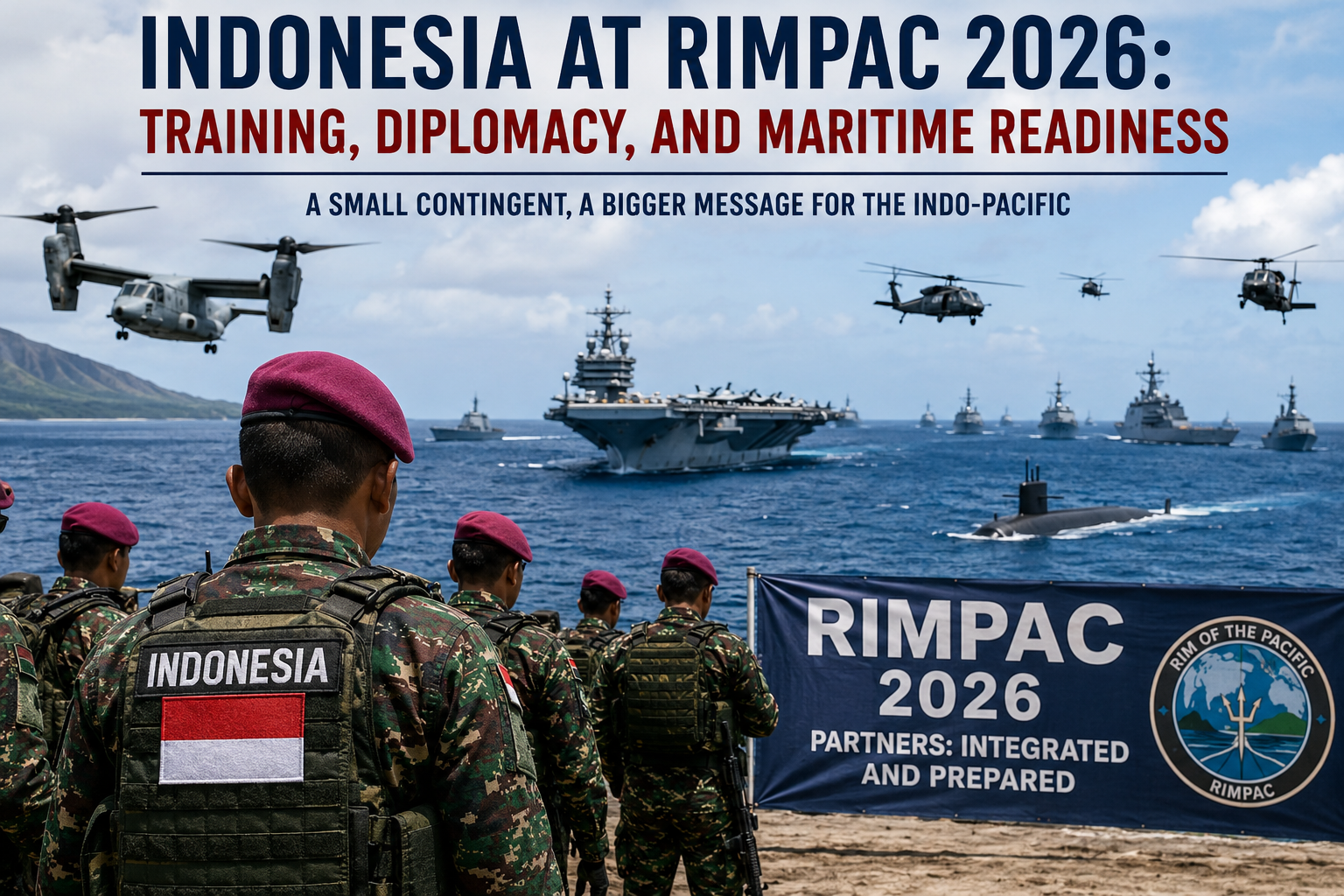
Indonesia’s role at RIMPAC 2026 may be modest in size, but it carries a wider message. By sending marines to the world’s largest international maritime exercise, Indonesia is showing that military preparedness and diplomacy now move together in the Indo-Pacific.
The drill gives the Indonesian Navy (TNI AL) practical training with foreign partners. It also reinforces Indonesia’s role as a serious maritime country and a regional leader in ASEAN.
Partners: Integrated and Prepared
The Rim of the Pacific Exercise, better known as RIMPAC, is a major multinational maritime drill held in and around the Hawaiian Islands.
RIMPAC 2026 runs from June 24 to July 31. This year marks the 30th edition of the exercise, which began in 1971. The United States Pacific Fleet hosts the drill, bringing together a wide network of navies, air forces, marine units and land forces.
This year’s drill involves 30 countries, more than 30 surface ships, five submarines, 15 national land forces, more than 206 aircraft and around 30,000 personnel.
The list of participating countries includes Indonesia, Australia, Brunei, Canada, Chile, Colombia, Denmark, Fiji, Germany, Greece, Guatemala, India, Israel, Italy, Japan, Malaysia, Mexico, the Netherlands, New Zealand, Peru, the Philippines, Poland, South Korea, Singapore, Spain, Sri Lanka, Thailand, Tonga, the United Kingdom and the United States.
The theme for this year is “Partners: Integrated and Prepared.” That phrase explains the core goal of the exercise. RIMPAC is designed to help different militaries operate together, communicate under pressure and respond to complex maritime situations.
Indonesia’s Role in RIMPAC 2026
Indonesia sent 35 personnel from the Indonesian Navy Marine Corps to Hawaii for RIMPAC 2026.
The number is small compared with the full scale of the exercise. But that does not make the participation meaningless. In military training, a small contingent can still gain valuable exposure, especially when the focus is specific and technical.
Before leaving for Hawaii, the Indonesian marines completed preparatory drills at home. Their preparation included zeroing and marksmanship training in Jakarta on June 8. They also conducted air mobility and fast-roping drills at Pondok Cabe Airfield in Tangerang, Banten, on June 20.
Once in Hawaii, Indonesian marines joined personnel from Malaysia, Fiji, Peru, Sri Lanka and the Philippines. Their training took place at Bellows Marine Corps Training Area near Honolulu.
The Indonesian marines took part in air assault and close-quarter battle drills. The air assault exercise used an MV-22 Osprey aircraft and simulated stages from landing to ground combat. The close-quarter battle training focused on area clearance, team coordination, rapid decision-making and tactical responses in urban environments.
These are the kind of skills that matter in real operations. Rapid movement, air-to-ground coordination and team discipline can decide whether a mission succeeds or fails.
The Importance of Maritime Training
For Indonesia, the world’s largest archipelagic state, maritime training is a national necessity. Its geography makes maritime security central to national defense, trade, logistics, disaster response and sovereignty.
RIMPAC drills include amphibious operations, gunnery and missile training, anti-submarine warfare, air defense, military medicine, humanitarian assistance and disaster response, counter-piracy, mine clearance, explosive ordnance disposal, diving and salvage operations.
An archipelagic country needs forces that can move between islands quickly. It needs personnel who understand amphibious operations and coastal environments. It needs maritime units that can respond to disasters, illegal activity, accidents and security threats across a wide area.
RIMPAC gives Indonesian personnel a chance to test skills in a multinational setting. It also exposes them to different procedures, equipment and operational habits. That kind of exposure matters because modern maritime challenges rarely fit neatly inside one country’s borders.
Military Preparedness as Diplomacy
RIMPAC is also a diplomatic platform.
Military diplomacy does not only happen in formal meetings. It also happens when officers plan together, train together and build trust before a crisis arrives. Those relationships can later matter during search-and-rescue operations, disaster relief, evacuation missions or regional security incidents.
Sea Lanes, Chokepoints, and Maritime Risk
Maritime security today is not only about warships. It also includes piracy, sea robbery, illegal fishing, smuggling, port security, energy flows and the protection of major sea lanes.
A crisis at sea can quickly become an economic crisis on land. The Strait of Hormuz is the clearest example. It sits far from Southeast Asia, but any serious disruption there can affect oil and gas supplies, shipping costs, inflation and energy prices around the world. When a chokepoint becomes unstable, the damage does not stay local.
Southeast Asia has its own strategic passages. The Strait of Malacca and the Singapore Strait connect the Indian Ocean with the South China Sea and the wider Pacific. These routes are vital for trade and energy shipments. They are also vulnerable to accidents, piracy, sea robbery and political pressure during a regional crisis.
Tensions Across the Indo-Pacific
The security picture around Asia is also becoming more tense. China has increased military pressure around Taiwan, while Taiwan continues to prepare for blockade and invasion scenarios. Japan is watching these developments closely because instability around Taiwan would directly affect Japanese security and nearby sea routes.
The South China Sea adds another major concern. China’s sweeping nine-dash-line claim, not recognized under UNCLOS, overlaps with the exclusive economic zones of countries such as the Philippines and Vietnam. China’s claim has also overlapped with waters near Indonesia’s North Natuna Sea.
A serious confrontation in the South China Sea would not only affect the countries directly involved. It could disrupt shipping routes, raise insurance and fuel costs, delay energy and goods deliveries, and force regional states to rethink maritime security almost overnight.
About the Author


2 thoughts on “RIMPAC 2026: Training, Diplomacy, and Maritime Readiness”
Comments are closed.