Indonesia’s 2026 El Niño has entered a strong phase just as the country reaches the peak of its dry season. Drought response is now under way in hundreds of locations, more than 107,000 hectares have been affected by forest and land fires, and rainfall is expected to remain unusually low across most of the country. Yet the same weather pattern is producing a windfall for some salt farmers and could benefit parts of the marine fishing industry.
El Niño is now firmly in the strong category
BMKG’s latest monitoring puts the Niño 3.4 sea-surface temperature anomaly above +2°C, firmly within the strong El Niño range.
By the end of July, 73.8% of Indonesia’s seasonal zones had entered the dry season. Around 76.3% of the country recorded below-normal rainfall.
For the second ten-day period of August, BMKG expects less than 50 millimetres of rain across 95.62% of Indonesia.
Another concern is the Indian Ocean Dipole, or IOD. It is currently leaning positive. If it strengthens, it can pull more moisture away from Indonesia and reinforce El Niño’s drying effect.
That does not mean rain disappears everywhere. Local atmospheric systems can still produce heavy downpours. The broader pattern, however, is increasingly dry and uneven.
Water shortages are spreading
The Public Works Ministry said it was responding to drought in 492 locations nationwide by early August.
The pressure is not limited to household water. Reservoirs and rivers also supply farms and hydroelectric plants. Falling water levels can therefore create competing demands between drinking water, irrigation and electricity generation.
BMKG has expanded weather-modification operations in fire-prone parts of Sumatra and Kalimantan. It has also targeted strategic catchments, including Lake Toba and the Citarum, Brantas and Mamasa river basins, to help protect water reserves.
Fires have moved from risk to emergency
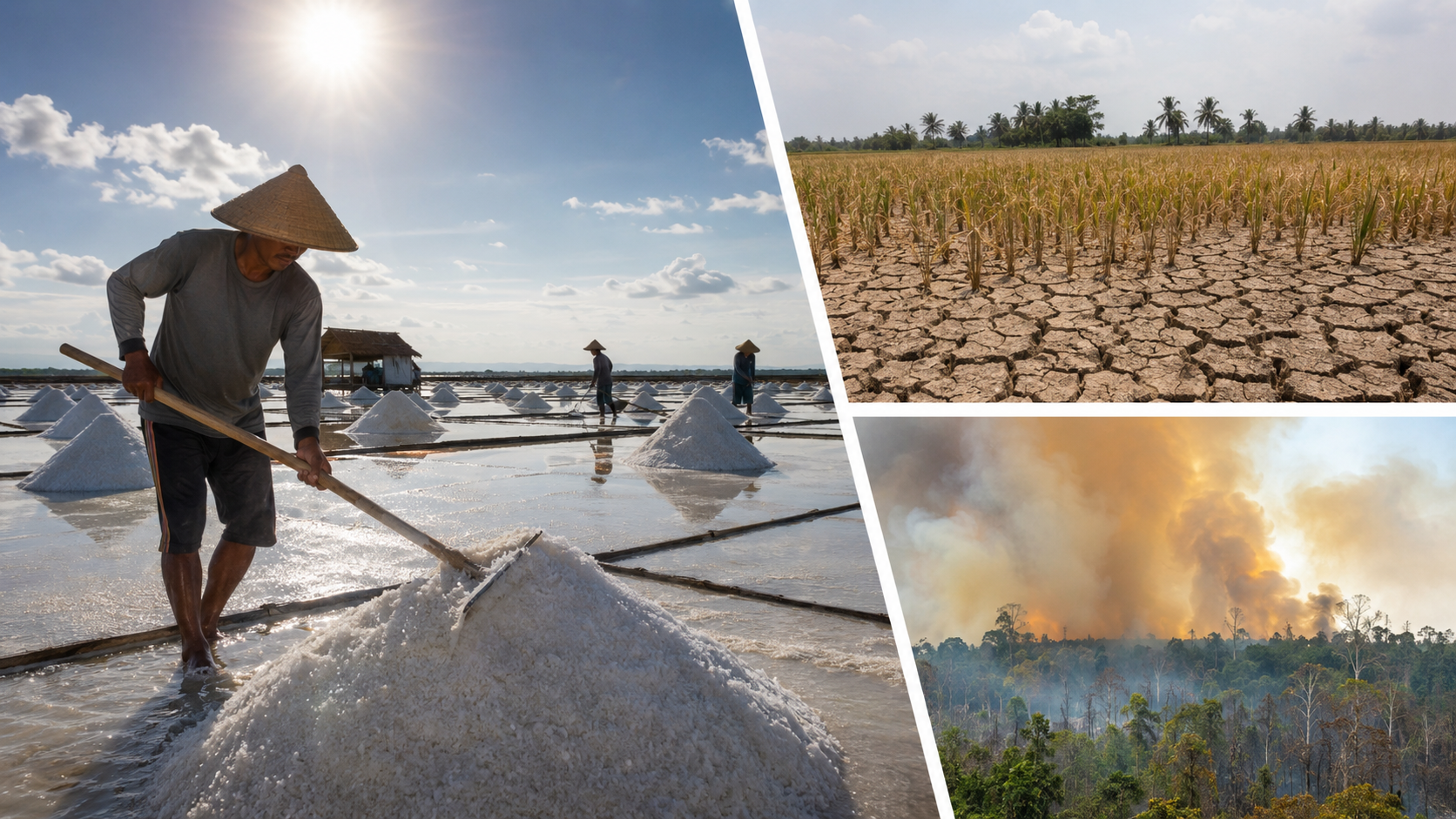
The fire situation has deteriorated quickly. Forestry Ministry data show that 107,465 hectares were affected by fire from January through June, more than double the area recorded during the same period of the 2023 El Niño year.
The government is concentrating firefighting resources in Riau, Jambi, South Sumatra, West Kalimantan, Central Kalimantan and South Kalimantan. Authorities have deployed helicopters and aircraft for water bombing, patrols and cloud seeding.
El Niño does not itself start these fires. Many Indonesian fires are linked to human activity, including land clearing. But prolonged drought dries vegetation and peat, making fires easier to ignite, harder to contain and capable of burning deep underground.
Haze has already worsened air quality in parts of Kalimantan. Schools in Pontianak moved classes online, while smoke has also raised concerns beyond Indonesia’s borders.
Food security is under pressure, but Indonesia has a buffer
Rice, oil palm and coffee are all vulnerable to prolonged water shortages. Farmers can face lower soil moisture, disrupted planting schedules and higher irrigation costs.
The government has prepared around 100,000 water pumps, repaired roughly 900,000 hectares of irrigation networks and prepared drought-resistant rice varieties.
For now, Indonesia has a substantial rice cushion. Government rice reserves stood at about 5.25 million tonnes at the end of July. The Agriculture Ministry also projects rice production of about 28.71 million tonnes from January through September and says it does not currently expect Indonesia to import rice in 2026.
That does not rule out local crop failures or food-price pressure if the drought persists.
El Niño also creates winners
The contrast is clearest in Indonesia’s salt fields.
Cirebon in West Java produced nearly 600 tonnes of salt in July, compared with only about 25 to 30 tonnes during the same month last year. Long rain-free periods allow seawater to evaporate efficiently, giving traditional salt producers longer uninterrupted harvesting periods.
National production shows the same relationship. Indonesia produced about 2.5 million tonnes of salt during the 2023 El Niño, before output fell to roughly 1 million tonnes last year amid wetter conditions.
A prolonged 2026 dry season could therefore produce another strong salt harvest.
Marine fisheries may also benefit in some areas. El Niño can strengthen upwelling, bringing cooler and nutrient-rich water toward the surface. This can improve conditions for pelagic fish such as tuna, skipjack and mackerel.
The benefit is not universal. Changes in water temperature and quality can hurt freshwater aquaculture and seaweed farming. Some horticultural and secondary crops may also benefit from drier conditions, but mainly where farmers still have reliable irrigation.
The hardest months may still be ahead
BMKG expects El Niño to last into early 2027, but its greatest impact on Indonesia should come while it overlaps with the dry-season peak in August and September.
Higher rainfall is expected to return gradually from October and November. A developing positive IOD could complicate that transition and prolong dry conditions in some regions.
Indonesia enters this period with substantial rice reserves, stronger monitoring and extensive mitigation measures. But strong Pacific warming, worsening fires and a prolonged dry season show that the country has not yet reached the end of the danger period.
About the Author