
Indonesian Unicorns
Indonesia built its startup reputation on scale: 270 million people, a mobile-first population, and a digital economy that has crept toward the $100 billion mark. For most of the 2010s, that scale translated into a steady stream of unicorns (startups valued at $1 billion or more). In 2026, that stream has run dry. Not a single Indonesian startup has crossed the unicorn threshold this year, and the country’s total sits at 13, a number that has barely moved since eFishery joined the club back in 2023.
To understand why, you have to look past the headline and at the money behind it.
By the Numbers
- 13 unicorns in Indonesia as of mid-2026 (no new additions this year)
- $9.4B peak venture funding in 2021
- $161M disclosed funding in H1 2026 (down more than 40% year-on-year)
- 69 funding rounds in 2025, down from roughly 385 in prior peak years
- 15% of seed-stage startups reached Series A in 2025
- 90% of Indonesia’s venture capital currently comes from foreign investors
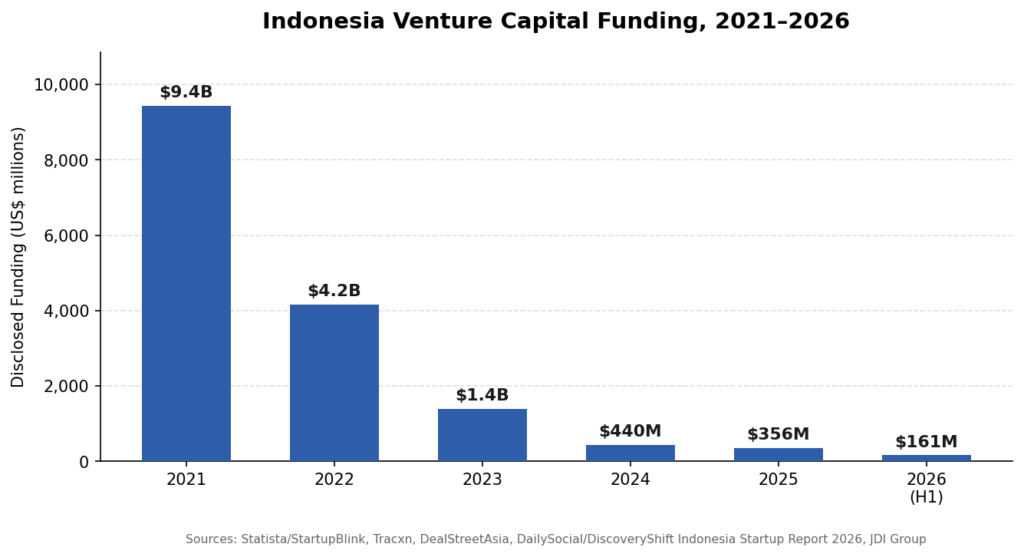
The Numbers Behind the Slowdown
Indonesia’s venture funding peaked at roughly $9.4 billion in 2021, during the pandemic-era rush into digital services. By 2024, that had collapsed to around $440 million (a decline of about 95%). The bleeding continued into 2025, when full-year venture funding bottomed out at roughly $356 million, with foreign investors supplying about 90% of that capital. Early 2026 hasn’t offered much relief either: disclosed funding in the first half of the year came in around $161 million, down more than 40% year-on-year.
The number of funding rounds tells a similar story. Deals fell from roughly 385 in earlier years to just 69 in 2025, a contraction industry watchers describe less as a collapse than a shakeout. Novrizal Pratama, Managing Director of Tech in Asia Indonesia, has framed the drop-off as a sign the ecosystem is maturing rather than dying, arguing that the end of the “pitch deck and spreadsheet” era forces founders to build real businesses instead of chasing valuation headlines.
Governance Scandals Made It Worse
The funding drought isn’t purely a story of global rate hikes and cautious LPs. Indonesia’s own governance problems have compounded it. Several former executives at government-backed venture firms were sentenced to prison on corruption charges, and industry figures point to those scandals as a direct drag on later-stage funding: institutional investors have grown warier of writing large checks into an ecosystem still working through credibility problems.
Where the Money Is Still Going
Fintech remains the one sector investors haven’t abandoned, even as overall funding fell sharply. Kredivo Group, the digital credit unicorn, pulled in more than $100 million in December 2025 led by longtime backer Mizuho Bank, followed by an expanded IDR 3 trillion financing facility from Bank DBS Indonesia in January 2026 to meet demand for buy-now-pay-later products. Consumer remains the single largest category by unicorn count (7), followed by fintech (6) and retail (4), a reminder that Indonesian tech has always been driven less by novel technology than by solving very local, very physical problems: how people pay, how goods move across thousands of islands, how small merchants get access to capital.
Agritech is the sector worth watching precisely because it’s still so small. eFishery remains the only agritech unicorn the country has produced, but the underlying sector (aquaculture, farm financing, crop technology) includes hundreds of smaller players attacking problems that fintech and e-commerce startups never touched.
A More Selective Market, Not a Dead One
It would be a mistake to read the unicorn drought as the end of Indonesian tech. Early-stage activity hasn’t disappeared; it’s just become harder to advance. Only about 15% of seed-stage startups managed to reach Series A funding in 2025, and early-stage deals made up roughly two-thirds of all Indonesian startup transactions that year. Investors are still writing checks; they’re simply demanding cleaner financials, clearer paths to revenue, and fewer promises about growth “at all costs.”
That shift mirrors what happened across Southeast Asia more broadly, but it lands harder in Indonesia because the country still depends so heavily on foreign capital and because its most recent unicorns (Traveloka, DANA, Akulaku, Kredivo, eFishery among them) were mostly minted years ago, during a very different funding climate.
What to Watch For
A few threads are worth following as 2026 progresses:
- Whether fintech consolidation continues. With Kredivo and a handful of others absorbing most of the available capital, smaller fintech players may face pressure to merge, pivot, or shut down.
- Whether agritech produces a second unicorn. eFishery’s rocky post-unicorn history (including a governance scandal of its own) makes this sector both promising and cautionary.
- Whether governance reforms restore investor confidence. The corruption sentences may mark a turning point rather than an ongoing liability, depending on how state-backed VC funds respond.
- Whether Indonesia loses ground to regional rivals. Singapore currently captures the overwhelming majority of Southeast Asia’s startup capital, and some reports suggest Indonesia has already fallen behind the Philippines in relative investment terms.
About the Author