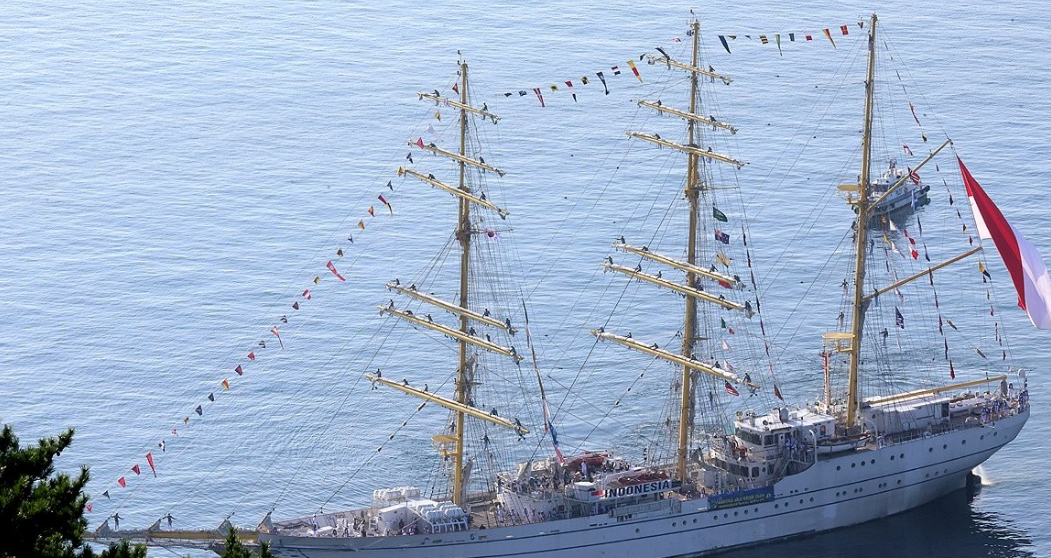
KRI Bima Suci
Indonesia is widening its maritime partnerships as regional waters become more contested. The latest signal came from Busan, but the pattern stretches from South Korea and Japan to Europe and Indonesia’s own strategic chokepoints.
Indonesian and South Korean Navy Officials Meet in Busan
Indonesia’s latest maritime partnerships were on display in Busan, South Korea, where Fleet Commander Vice Admiral Denih Hendrata met Republic of Korea Fleet Deputy Commander Rear Admiral Lee Namgyu aboard KRI Bima Suci. The June 3 meeting formed part of the 2026 Diplomatic Voyage Visit and Kartika Jala Krida cadet training program, but it carried a message beyond ceremony: Indonesia is using naval diplomacy to widen its room for maneuver.
The Busan visit mixed training, culture, and defense outreach. Indonesian naval cadets promoted Indonesian arts, while senior officers discussed stronger military cooperation and possible collaboration in maritime defense.
From Busan to Tokyo
In May, Japan’s destroyer JS Ikazuchi visited Tanjung Priok, where Indonesian and Japanese naval officials discussed regional maritime security coordination and possible expanded joint exercises. The visit followed Prabowo Subianto’s March 31 meeting in Tokyo with Japanese Prime Minister Sanae Takaichi, after his audience with Emperor Naruhito. That summit covered trade, energy, industrialization, critical minerals, education, tourism, and security, while later defense talks pushed the relationship toward training, joint exercises, maritime security, and defense industry cooperation.
Japan deserves special attention because it faces China’s pressure closer to home. Tokyo watches the East China Sea, the Taiwan Strait, and western Pacific routes with growing concern. For Indonesia, cooperation with Japan means learning from a partner that understands how gray-zone pressure works: patrols, coast guard presence, legal claims, and repeated movements that try to make a new reality feel normal.
Maritime Partnerships and the Natuna Question
Jakarta does not present itself as a South China Sea claimant in the same way as the Philippines or Vietnam. Still, Chinese coast guard and fishing activity near Indonesia’s exclusive economic zone has made the North Natuna Sea a test of sovereignty.
That is why naval and coast guard cooperation matters. Indonesia needs ships, surveillance, training, legal clarity, and partners who respect open sea lanes. The issue is not only about warships. It is about whether Indonesia can defend its maritime rights without shouting, drifting, or becoming dependent on any single power.
Indonesia’s Maritime Outreach is not Limited to Northeast Asia.
Dutch warship HNLMS De Ruyter visited Surabaya in May, and both navies discussed stronger defense cooperation, exercises, operations, and education.
Indonesia has also trained with Pakistan in the Java Sea, a reminder that Jakarta still prefers broad defense diplomacy rather than a simple pro-Western alignment.
Strategic Waters Beyond Natuna
For an archipelagic country like Indonesia, diplomacy at sea is not symbolic. It is part of national security.
Indonesia’s maritime agenda does not end at Natuna. Bakamla patrols cover strategic waters such as Natuna, Aceh, and the Malacca Strait, while drills around the Singapore Strait highlight threats from smuggling, illegal activity, and maritime crime. Free navigation through these chokepoints is essential for trade, energy flows, and the daily stability of the region.
A Taiwan Strait crisis would affect Japan, disrupt trade, and pressure sea routes through Southeast Asia. From Busan to Tokyo, Indonesia is not abandoning its independent foreign policy; it is updating it for a region where sovereignty depends on readiness, partnerships, and control of the sea.
About the Author