
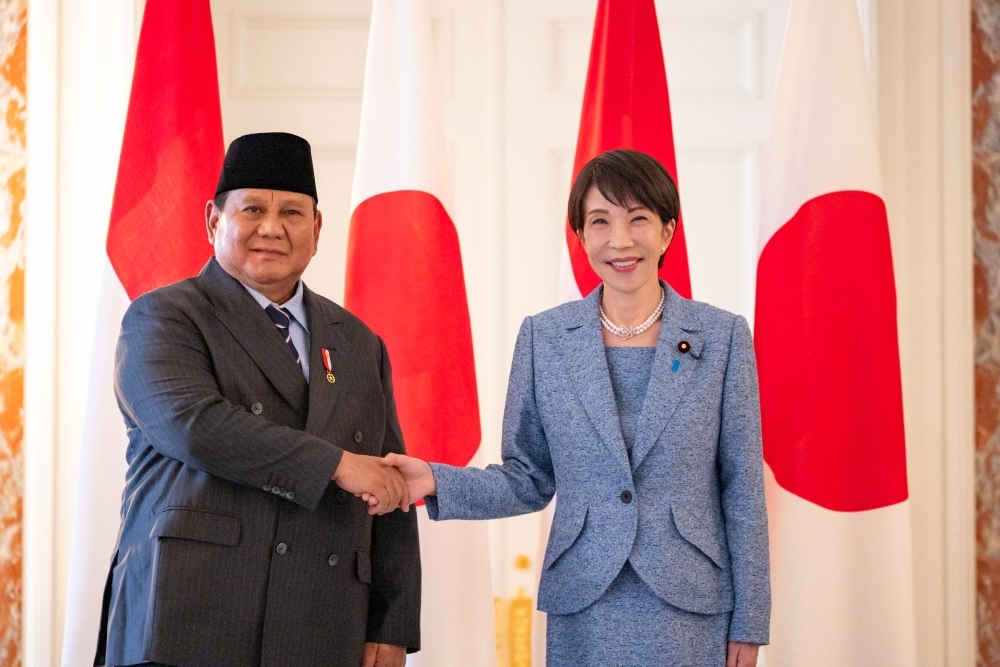
Japan-Indonesia Summit
President Prabowo Subianto’s visit to Japan gave fresh momentum to the Indonesia-Japan partnership, moving it beyond ceremony and into a more practical phase. In Tokyo on March 31, Prabowo met Prime Minister Sanae Takaichi after an audience with Emperor Naruhito. The summit covered trade, energy, industrialization, critical minerals, education, tourism, and security. The message was clear: Jakarta and Tokyo want a wider relationship as the Indo-Pacific grows less predictable.
Prabowo said Indonesia would accelerate the amended Indonesia-Japan Economic Partnership Agreement. That fits his economic agenda. Indonesia wants more downstream processing, more industrial value at home, and more foreign investment that does not leave the country stuck as a raw-material supplier.
Japan also has strong reasons to lean in. Indonesia sits near vital sea lanes, including the Strait of Malacca. It holds important mineral and energy resources. It also offers Japan a large democratic partner in Southeast Asia as maritime security becomes a central regional concern.
Defense Ties Move From Courtesy To Capability
Indonesian Defense Minister Sjafrie Sjamsoeddin met Japanese Defense Minister Shinjiro Koizumi in Japan in April, with maritime defense high on the agenda. The two ministers then held follow-up meetings in Bali on May 3 and Jakarta on May 4.
Those talks produced a Defense Cooperation Arrangement covering personnel exchanges, education and research, joint exercises, maritime security, disaster response, and defense industry cooperation. This points to practical capacity-building in patrols, training, surveillance, technology, and coordination at sea.
That matters because the region’s main pressure points are maritime. Governments now face a gray zone where coast guards, fishing fleets, naval ships, and disputed claims often overlap. For Indonesia and Japan, the sea is no longer just a trade route. It is a test of sovereignty.
China’s Maritime Conduct Forms The Strategic Backdrop
Official statements avoided naming China directly, but the regional security context is difficult to miss.
Japan faces regular pressure around the Senkaku Islands, a small uninhabited group in the East China Sea administered by Japan and claimed by China, which calls them Diaoyu. The islands sit northeast of Taiwan and west of Okinawa. Their importance is not only symbolic. They touch fisheries, shipping routes, possible seabed resources, and the wider contest over control in the first island chain.
Tokyo says Chinese government vessels have repeatedly entered waters around the Senkakus since 2008. Beijing presents these movements as normal patrols. Japan sees them as attempts to weaken Japanese control without triggering open conflict. Southeast Asians will recognize the method.
Indonesia faces a different, but related, problem near the Natuna Islands. Jakarta does not call itself a South China Sea claimant in the same way as the Philippines or Vietnam. Yet Chinese fishing vessels and coast guard ships have repeatedly appeared near Indonesia’s exclusive economic zone. Beijing’s sweeping claims overlap with waters Indonesia considers part of its lawful maritime rights. Natuna has become one of the places where Indonesia’s non-aligned foreign policy meets China’s expansive maritime claims.
The Importance of the Indonesia-Japan Partnership
Taiwan is not the direct subject of these meetings, but it sits in the background of Indo-Pacific planning. A Taiwan Strait crisis would affect Japan immediately, disrupt trade, draw in the United States, and pressure sea lanes through Southeast Asia.
Indonesia has no interest in being dragged into a great-power conflict. Still, it has every reason to support open seas, stable trade, and a regional order where powerful states do not decide the fate of smaller societies by force. Taiwan’s people have built a democratic life of their own. Their future should not be treated as a bargaining chip on someone else’s map.
The Strait of Malacca adds another layer. This narrow corridor between Indonesia, Malaysia, and Singapore remains one of the world’s busiest shipping routes. Indonesia’s recent Bakamla patrols cover strategic waters including Natuna, Aceh, and the Malacca Strait.
For Japan, which depends heavily on imported energy and open sea lanes, Indonesia’s role is hard to overstate. For Indonesia, Japan offers technology, investment, maritime experience, and a democratic partner that understands Chinese pressure from its own neighborhood.
About the Author



2 thoughts on “Indonesia-Japan Partnership Deepens After Prabowo’s Tokyo Visit”
Comments are closed.