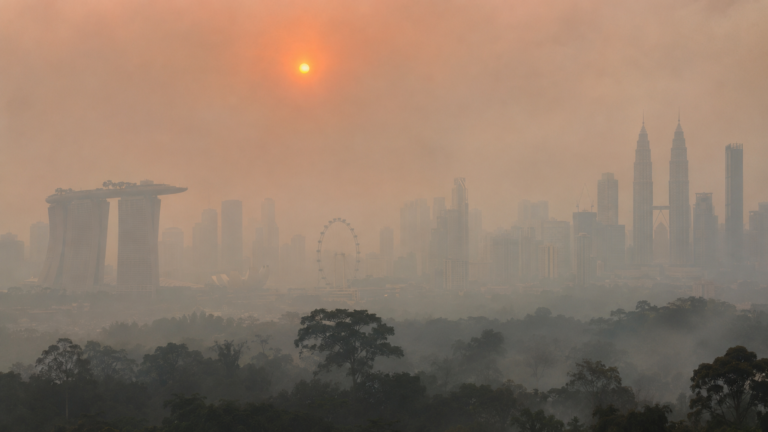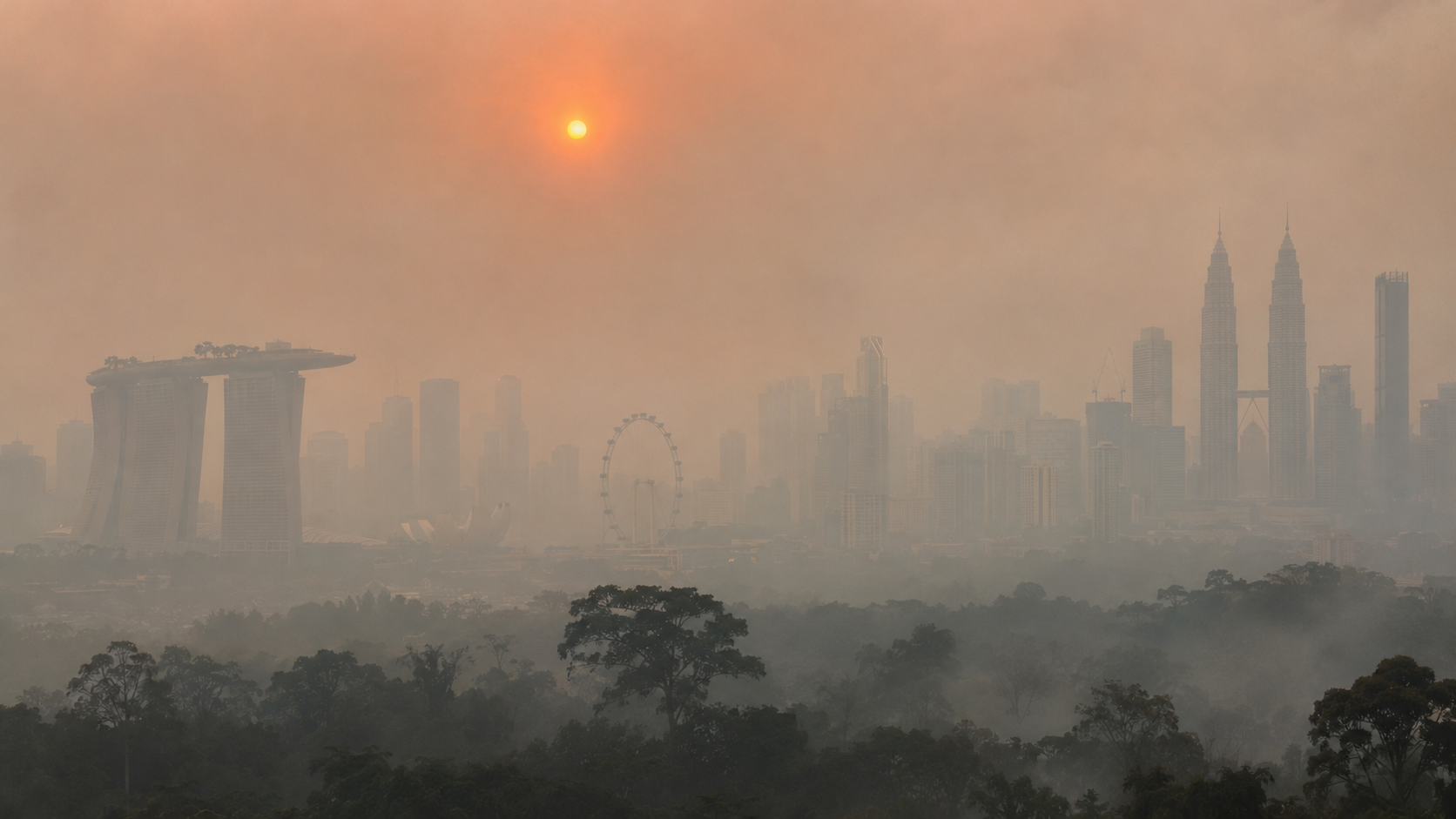
Rainfall has brought much-needed relief to Indonesia and its Southeast Asian neighbours after weeks of wildfire smoke. On November 5, the ASEAN Specialised Meteorological Centre (ASMC) lowered its regional haze alert to Level 1, citing fewer hotspots and improved conditions across southern ASEAN.
In Sumatra, satellite detections dropped from 64 hotspots on November 3 to just seven the following day. However, Kalimantan recorded an increase from 13 to 34 hotspots, showing that the improvement was uneven.
Singapore also began lifting emergency measures. On November 5, its air quality index stood at 56–64, within the moderate range. Authorities subsequently ended mask distribution and closed designated haze shelters on November 7.
Although the immediate health risks have eased, isolated fires and localised smoke remain a concern.
Indonesia’s wildfires have sparked disagreements with Singapore and Malaysia over corporate responsibility, cross-border pollution and government accountability. Now, attention is turning to ASEAN and whether its members can prevent another regional crisis.
Wildfires strain Indonesia’s relations with its neighbours
The haze, largely originating from forest and peatland fires in Sumatra and Kalimantan, spread across national borders in October, affecting air quality and daily life in neighbouring countries.
On October 8, Malaysian Prime Minister Anwar Ibrahim contacted President Prabowo Subianto, urging stronger measures to control the fires. Malaysia also offered assistance and called for greater regional coordination.
Singapore took a more confrontational approach, seeking to investigate companies potentially responsible for the fires under its environmental laws.
Prabowo responded by criticizing unnamed foreign countries for what he considered disrespectful statements about Indonesia. He also argued that foreign-linked companies should share responsibility for environmental damage.
The disagreements highlighted a difficult question: Who should be held accountable when pollution originates in one country but affects millions of people across several others?
Indonesia and Singapore agree to cooperate
Despite the tensions, Indonesia and Singapore took an important diplomatic step on October 27. Foreign Ministers Arrmanatha Nasir and Vivian Balakrishnan agreed to establish a joint task force investigating companies linked to forest and land fires. The initiative aims to improve information sharing, exchange financial intelligence and gather evidence across borders. Both governments emphasized that businesses responsible for illegal burning should face consequences, regardless of where they are registered.
The agreement represents a shift from diplomatic disagreements toward practical cooperation, although its effectiveness will depend on enforcement.
Why has ASEAN struggled to prevent recurring haze?
The ASEAN Agreement on Transboundary Haze Pollution, signed in 2002 and effective since 2003, commits participating countries to preventing, monitoring and controlling forest and land fires. Yet more than two decades later, severe haze continues to affect the region.
One major difficulty is enforcement. Forest management and environmental regulations remain largely under national jurisdiction. Meanwhile, companies operating across borders can complicate investigations and accountability.
Preventing fires also requires more than firefighting. Drained peatlands are especially vulnerable to burning, making sustainable land management, peatland restoration and early detection essential.
Indonesia pushes for a stronger ASEAN response
Indonesia is now advocating a significant step toward regional cooperation. On November 4, its Foreign Ministry announced plans to push for ratification of the agreement establishing the ASEAN Coordinating Centre for Transboundary Haze Pollution Control at the upcoming ASEAN Summit in Manila.
The centre already has a secretariat in Jakarta but cannot begin operating until at least six ASEAN member states ratify its establishment agreement. As of November 4, only Vietnam had completed the process. Once operational, the centre could strengthen regional monitoring, improve information sharing and coordinate responses to future fires. Singapore has also pledged to support the centre and strengthen implementation of ASEAN’s haze agreement during its 2027 chairmanship.
These initiatives could help countries identify fire risks earlier, coordinate resources more effectively and strengthen corporate accountability.
Can ASEAN prevent the next wildfire crisis?
The return of rainfall has offered Indonesia and its neighbours temporary relief. But the next dry season will bring another test of the region’s ability to cooperate.
With Indonesia pushing to activate the Jakarta-based haze coordination centre and Singapore preparing to chair ASEAN in 2027, the coming months offer an opportunity for progress.
About the Author