Indonesia’s financial markets have experienced a turbulent few days, following a warning that the country could lose its place in a major international investment index. Stock prices fell sharply before recovering some ground on October 20, offering a reminder of both the challenges facing Indonesia’s financial system and its capacity to respond.
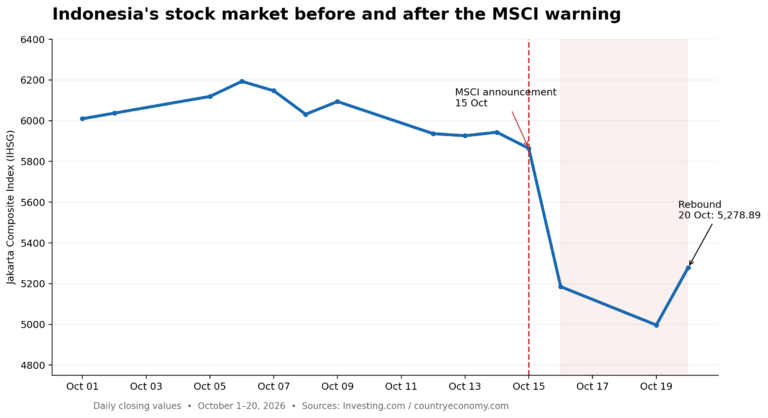
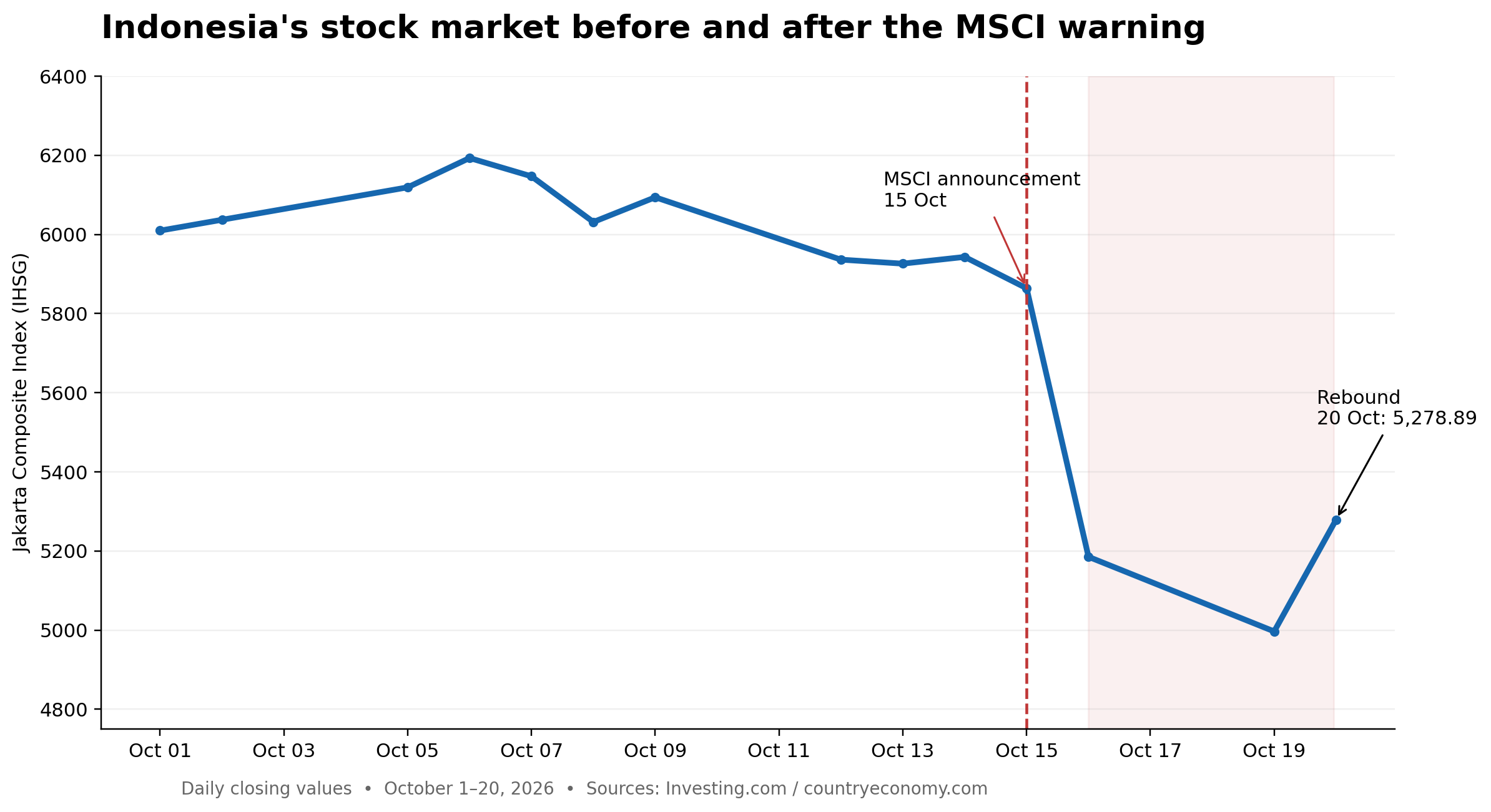
The warning came from MSCI, a global provider of stock market indexes. On October 16, Jakarta’s main stock index plunged 11.6%, its steepest daily fall since the 1998 Asian financial crisis. Losses continued on October 19, bringing the two-day decline to nearly 15%.
The selloff erased approximately $82 billion in market value. Yet Indonesia’s economy remains much larger than its stock market, and the proposed downgrade does not mean the country is facing an economic collapse.
Understanding MSCI and its market classifications
MSCI creates indexes that help international investors decide where to invest.
An index is essentially a basket of shares representing a particular market. For example, the MSCI Emerging Markets Index includes major economies such as China, India, Brazil, and Indonesia. International investment funds use it to build portfolios and measure performance.
MSCI divides markets into four broad categories:
- Developed markets: Established financial markets, including the United States, Japan, and Germany.
- Emerging markets: Countries such as Indonesia, India, China, and the Philippines.
- Frontier markets: Smaller or less accessible markets, including Vietnam and Pakistan.
- Standalone markets: Markets that do not qualify for inclusion in the main developed, emerging, or frontier indexes, often because of accessibility or trading concerns.
Indonesia has enjoyed emerging-market status since 1989.
MSCI is now considering moving it directly to standalone status, effectively excluding Indonesian stocks from major international indexes followed by large investment funds.
Such a decision would not prohibit foreign investment. However, funds tracking these indexes could have to sell Indonesian shares. Other investors might also reduce their exposure, potentially making it harder for companies to raise capital.
The downgrade is not yet final. MSCI will accept feedback until April 30, 2027, with a decision expected by June 30.
The concerns behind the warning
MSCI’s main complaints concern transparency and fairness in Indonesia’s stock market. Ownership of some listed companies is concentrated among a small number of shareholders. In certain cases, the identities and relationships of major investors remain insufficiently transparent.
This raises concerns about market manipulation and coordinated trading, particularly when relatively few shares are available for public trading.
MSCI had already raised these problems earlier in 2026. Although Indonesian authorities announced reforms, the index provider says investors have not yet seen convincing evidence of sustained improvements.
The warning also comes amid broader financial pressures, including a weakening rupiah and questions about Indonesia’s fiscal policies. However, these wider economic concerns should be distinguished from MSCI’s specific criticisms of stock market governance.
Stock market rebounds after government intervention
Indonesian authorities have moved to address the concerns and stabilize trading.
The Indonesia Stock Exchange announced plans to remove shares with highly concentrated ownership from its main benchmark index. Around 80 companies, representing approximately 18% of the index’s weighting, could be affected. These companies would remain publicly traded, but their price movements would no longer influence the benchmark.
Other measures include stronger disclosure of shareholders holding at least 1% of a company’s shares, tighter daily share-price limits, and a proposed minimum public shareholding of 15%.
Financial regulators have also imposed substantial fines for market violations.
Investors reacted positively
On October 20, the Jakarta Composite Index rebounded approximately 5.3%. The recovery suggests that the initial selloff may have reflected some excessive short-term panic. It also indicates that investors are willing to respond to credible corrective measures.
Nevertheless, one day of gains cannot erase the underlying problems. Whether the recovery continues will depend partly on the effectiveness of the promised reforms.
Lessons from other countries
Indonesia is not the first country to face removal from a major MSCI market category.
Argentina was downgraded to standalone status in 2021 after capital controls restricted foreign investors’ ability to move money out of the country.
Russia received the same classification in 2022, when sanctions and market restrictions following its invasion of Ukraine made normal international investment extremely difficult.
Pakistan moved from emerging to frontier status in 2021 after its stock market no longer met MSCI’s size and liquidity requirements.
There are also encouraging examples. Bulgaria was reclassified from standalone to frontier status in 2026, demonstrating that countries can improve their market classification.
These cases involve very different circumstances. They show that index status depends not only on a country’s economic size, but also on how accessible and reliable its financial markets are.
Beyond the stock market: Indonesia’s economic outlook
MSCI’s concerns appear substantial and deserve a serious response. Investors need transparent ownership structures, fair trading conditions, and regulators capable of enforcing the rules.
At the same time, a proposed downgrade should not be mistaken for a verdict on Indonesia’s entire economy. The country retains significant advantages, including a large domestic market, abundant natural resources, a growing industrial sector, and considerable long-term development potential.
President Prabowo Subianto’s government also faces difficult choices. Its ambitious development and social spending programs could support economic growth, but they require credible financing and predictable policies.
Maintaining fiscal discipline while strengthening financial institutions will help reassure investors.
Indonesia still has time to prevent the downgrade
The priority should not simply be persuading MSCI to reverse its position, but making the country’s stock market genuinely more transparent and trustworthy.
The October 20 rebound offers grounds for cautious optimism, although it is too early to declare the turmoil over.
Indonesia’s economic strengths have not disappeared because of a stock market warning. With effective reforms and consistent policymaking, the country has the foundations to recover from this episode and emerge with a stronger financial system.
About the Author