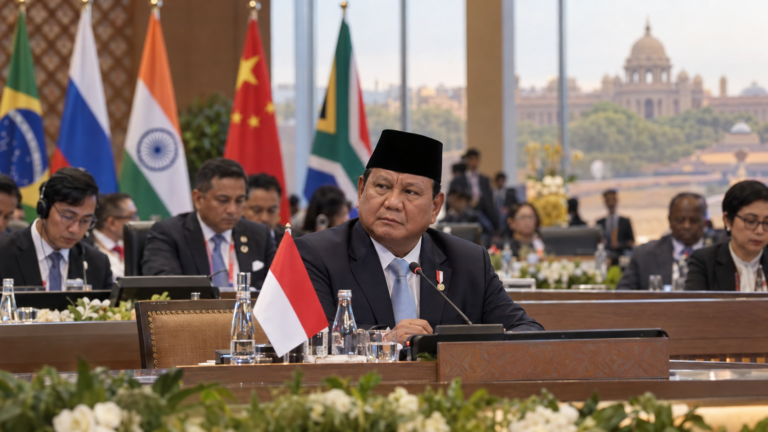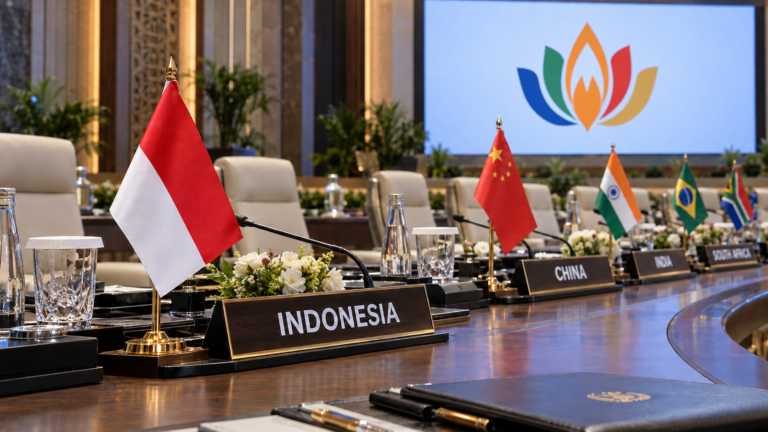
Indonesia used the 2026 BRICS Summit to promote cooperation on industrialization, food security and energy independence. The objective reflected a wider ambition: developing countries should capture more value from their resources and become less vulnerable to decisions made elsewhere.
BRICS could give Indonesia new markets, investment and technology. But if China supplies much of the infrastructure behind these initiatives, the bloc may deepen one of Indonesia’s existing dependencies instead of reducing it.
China’s growing influence over BRICS
Chinese President Xi Jinping proposed more integrated markets and supply chains, a partnership linking BRICS special economic zones and a BRICS AI Open Source Zone led by China. Beijing will also host a BRICS Service Trade Forum when it assumes the bloc’s presidency in 2027.
These plans could attract manufacturing and make technology more accessible. However, BRICS has not resolved who will finance the infrastructure, supply the technology or establish the rules.
China’s economy and industrial resources are substantially larger than those of most other members. Cooperation among formally equal countries could therefore develop around Chinese companies, standards and financial systems, giving Beijing disproportionate influence over the bloc’s practical direction.
A warning from Indonesia’s nickel industry
Indonesia has already experienced the difference between domestic production and domestic control.
Chinese investment helped it build smelters and become the world’s leading nickel producer. Yet Chinese companies control much of the technology, financing and refining capacity behind that expansion.
The lesson is not to reject Chinese investment. It is to ensure that BRICS projects create competitive Indonesian companies rather than simply placing foreign-controlled facilities on Indonesian soil.
Who controls BRICS payments?
The summit supported greater use of national currencies in trade and further work on connecting payment systems and central-bank digital currencies. This could reduce transaction costs and provide alternatives during periods of financial instability.
But payment infrastructure is not neutral. Its operators can influence technical standards, participation and access.
India stayed away from the China-linked mBridge digital currency platform and stalled a proposed connection between its payment systems and Alipay+. This showed that concerns about control exist even among major BRICS members.
Indonesia should support payment cooperation only when governance is shared and platforms remain compatible with systems outside China. Replacing dependence on Western networks with a Chinese-centred alternative would not strengthen Indonesian autonomy.
AI cooperation or technological dependence?
China’s proposed AI initiative could help Indonesian companies, universities and government agencies adopt artificial intelligence more quickly.
However, AI also depends on chips, data centres, cloud services and technical expertise. If essential Indonesian services rely on systems that only Chinese suppliers can maintain, affordable cooperation could create expensive long-term dependence.
Indonesia should retain control over sensitive data, require genuine knowledge transfer and preserve the ability to change providers. BRICS cooperation should help the country develop its own researchers, computing capacity and Indonesian-language models rather than remain permanently dependent on foreign systems.
Dependence can restrict political choices
Economic dependence can eventually affect foreign policy. A confrontation over Taiwan, sanctions against Chinese companies or serious instability in the South China Sea could disrupt technology, investment and exports even if Indonesia were not directly involved.
Indonesia also has maritime disagreements with China around the North Natuna Sea. Excessive economic exposure could make defending Indonesian interests more costly if political relations deteriorated.
That would conflict with Indonesia’s bebas aktif principle. Strategic autonomy requires the practical ability to disagree with any major power without placing crucial industries at immediate risk.
BRICS can strengthen Indonesian self-reliance, but only if it gives the country more partners and more choices. If its emerging economic architecture becomes centred on Chinese capital, technology and rules, Indonesia may simply exchange one form of dependence for another.
About the Author