Tibet visit
A senior Chinese leader’s visit to Tibet has turned China’s new ethnic unity law from a legal debate into a live political issue.
A High-Level Visit Brings the New Law Into Practice
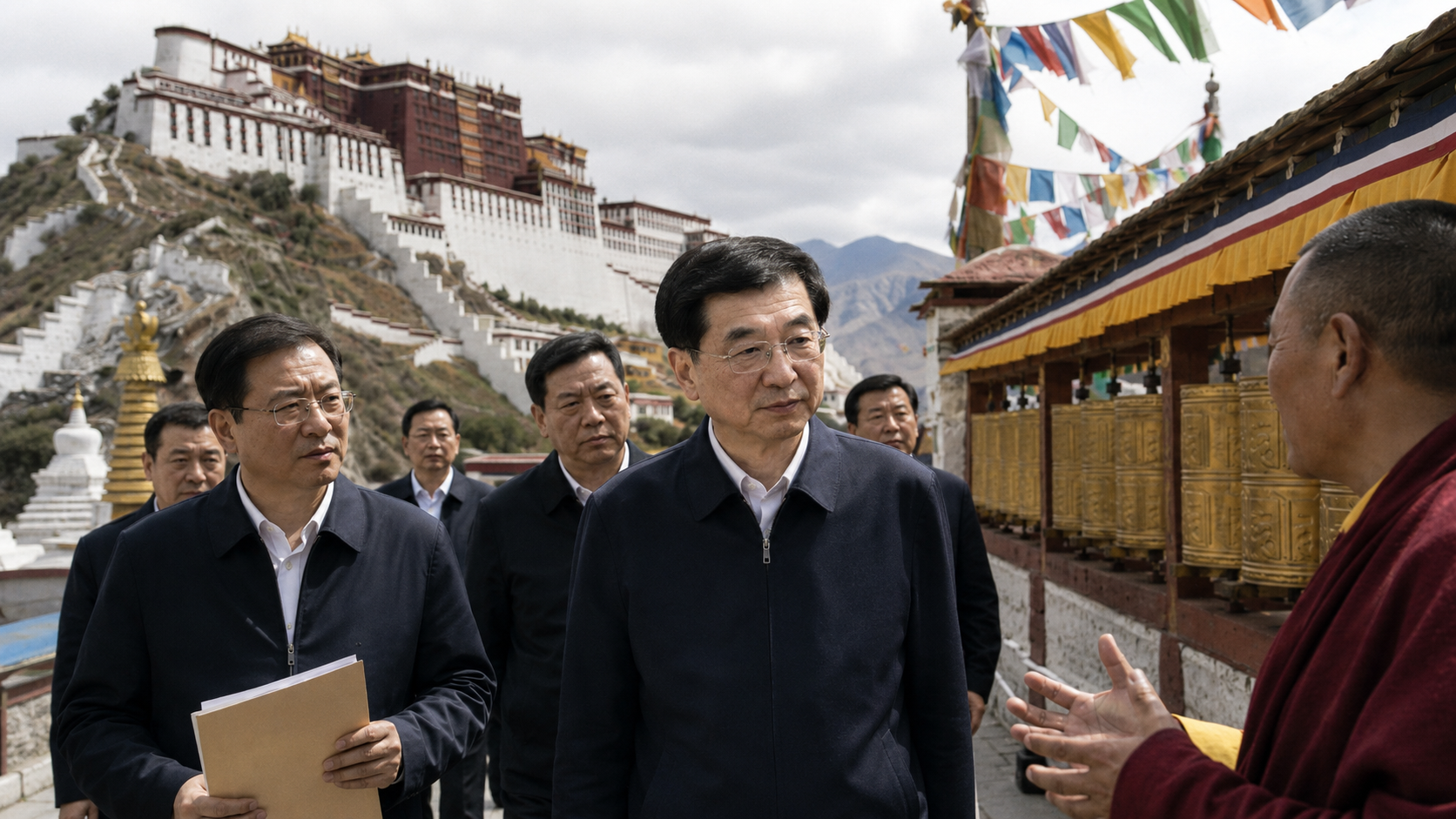
Wang Huning, China’s fourth-ranking leader and chairman of the Chinese People’s Political Consultative Conference, toured Tibet from July 19 to 22. During the visit, he called for the full implementation of the Ethnic Unity and Progress Promotion Law, which took effect on July 1.
The law was already controversial. Beijing says it promotes unity, development, and harmony among China’s ethnic groups. Critics say it gives the state another tool to pressure minorities into accepting a single, Communist Party-approved national identity.
Wang’s Tibet visit now shows where that concern may become concrete.
Tibet And The Law’s First Major Test
Chinese state accounts of the visit said Wang stressed social stability, ethnic unity, and the implementation of the law in Tibet. He also called for efforts to guide Tibetan Buddhism to “adapt to socialist society,” in line with Beijing’s policy of promoting the Sinicisation of religion.
That phrase matters. It does not simply mean religion existing peacefully inside China. It means religion being reshaped to fit the political priorities of the Chinese Communist Party.
For Tibetans, this is especially sensitive. Tibetan Buddhism is tied closely to Tibetan culture, education, language, and identity. China already insists that it has authority over the selection of the Dalai Lama’s successor. Many Tibetans and rights groups see that as direct political interference in religious life.
The International Campaign for Tibet said Wang’s visit signaled Beijing’s push to accelerate implementation of the law in Tibet. The group argues that the law provides a framework for deeper assimilation, ideological control, and security governance.
National Unity or Minority Repression?
The ethnic unity law promotes a “strong sense of community for the Chinese nation.” It also supports the use of standard spoken and written Chinese. Beijing says minority languages and rights remain protected, but critics question whether that promise matches China’s conduct.
In Tibet, rights groups have long warned about Mandarin-centered education and pressure on Tibetan-language learning. In Inner Mongolia, earlier school language changes reduced the use of Mongolian in key subjects and triggered protests. In Xinjiang, Uyghur Muslims have faced sweeping controls over religion, language, culture, and family life under the language of anti-extremism and stability.
The issue is not only whether China uses the word “unity.” The issue is whether unity means equal citizenship, or political obedience.
About the Author