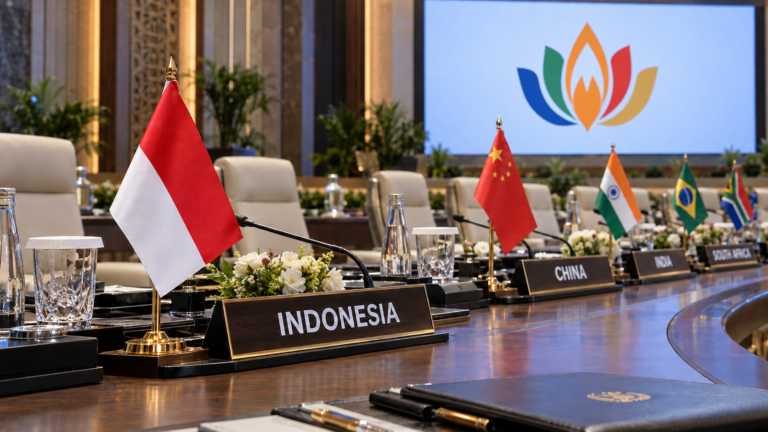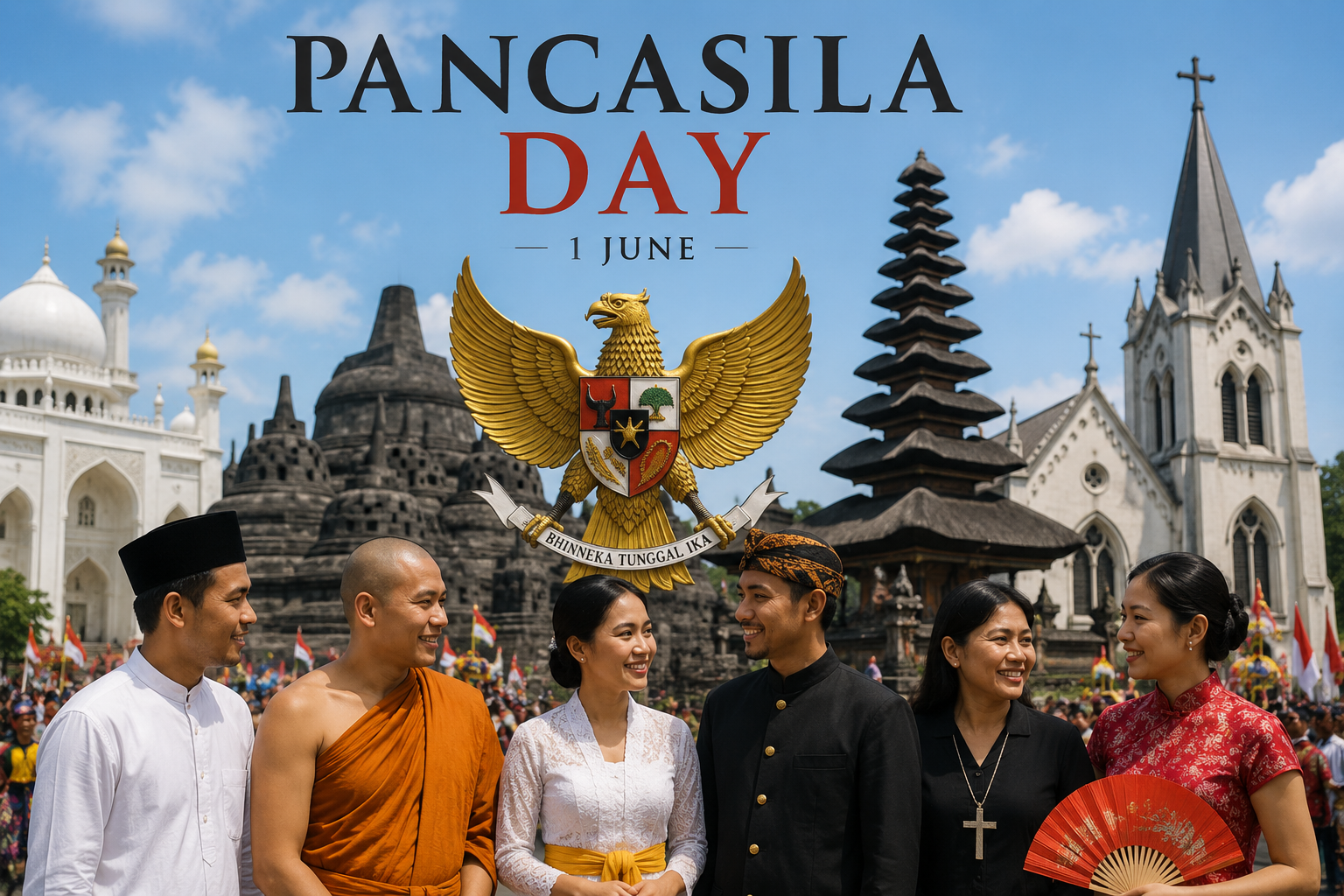
Pancasila Day arrives this year after a striking national sequence: Eid al-Adha on May 27, a collective holiday on May 28, Waisak or Vesak on May 31, and the June 1 commemoration itself.
Vesak marks the birth, enlightenment, and death of the Buddha, and in Indonesia it is often observed through prayers, processions, and ceremonies at Buddhist temples, including Borobudur.
In one long weekend, Indonesia’s calendar tells a larger story about the country: faith matters deeply here, but no single community owns the republic.
That is the quiet genius of Indonesia. It is the world’s largest Muslim-majority country, but it is not built as a narrow religious state. Its national identity also makes room for Christians, Hindus, Buddhists, Confucians, local traditions, and hundreds of ethnic and regional cultures.
This is not a small achievement. Many diverse countries speak of unity. Indonesia has had to practice it every day, across islands, languages, religions, and political moods.
Pancasila Is More Than Ceremony
Pancasila was born from the political imagination of independence. On June 1, 1945, Sukarno presented ideas for the philosophical foundation of a future Indonesian state. The final formulation later became the basis of the republic: belief in one God, just and civilized humanity, national unity, deliberative democracy, and social justice.
Those principles answer a difficult question: how can a country with such diversity remain one nation without erasing its differences?
Indonesia’s answer was not aggressive secularism. It was also not theocracy. Instead, the country built a civic framework where religion has public meaning, but national belonging does not depend on one sect, ethnicity, or region.
That balance remains one of Indonesia’s greatest contributions to the modern world.
Pancasila Day and Indonesia’s Tolerant Islam
The Indonesian version of Islam has often been shaped by local culture, social moderation, pesantren traditions, civic organizations, and a long habit of living beside other faiths. Nahdlatul Ulama and Muhammadiyah, in different ways, helped build a public Islam that could serve society without needing to dominate the state.
This does not mean Indonesia is perfect. Churches, minority Muslim groups, local believers, and other communities have faced pressure in different places and periods. But comparison matters. In China, Uyghur Muslims and other minorities have faced severe repression in Xinjiang. In Iran, religious authority and political control still leave little space for democratic freedom.
Indonesia’s imperfections should not obscure its larger achievement: a Muslim-majority democracy with real pluralistic space. Freedom House gives Indonesia a Global Freedom Score of 56 out of 100 and rates it “Partly Free.” China scores 9, Iran 10, and Russia 12, with all three rated “Not Free.” That gap is significant. It reflects a real difference in civic life, political space, and the everyday freedom available to religious and ethnic communities.
Indonesia shows that Islam can be confident without becoming coercive. It can be public without becoming hostile to pluralism. It can shape moral life while still sharing a republic with others.
That is why this commemoration should not be treated as a dry patriotic ritual. It is a reminder that Indonesia’s Islam, at its best, is not weakened by tolerance. It is strengthened by it.
Pluralism Works When It Is Protected
Recent data gives Indonesia reason for pride, while also showing where further improvement is still needed. The Religious Affairs Ministry said the 2025 Religious Harmony Index reached 77.89, the highest score since the survey began in 2015. The ministry also reported a 2025 Religious Piety Index of 84.61, suggesting that public religiosity and social harmony can coexist rather than cancel each other out.
A 2026 LSI survey also found that 97.3 percent of respondents said they felt free to practice their religion. Those numbers are encouraging. They suggest that most Indonesians still experience religious life as open, public, and protected.
Still, the data also shows why Indonesia should keep improving. Setara Institute recorded 221 religious freedom violations in 2025, down from 260 in 2024. That decline is a positive sign, and it suggests that pressure, public debate, and institutional attention can make a difference.
About the Author