
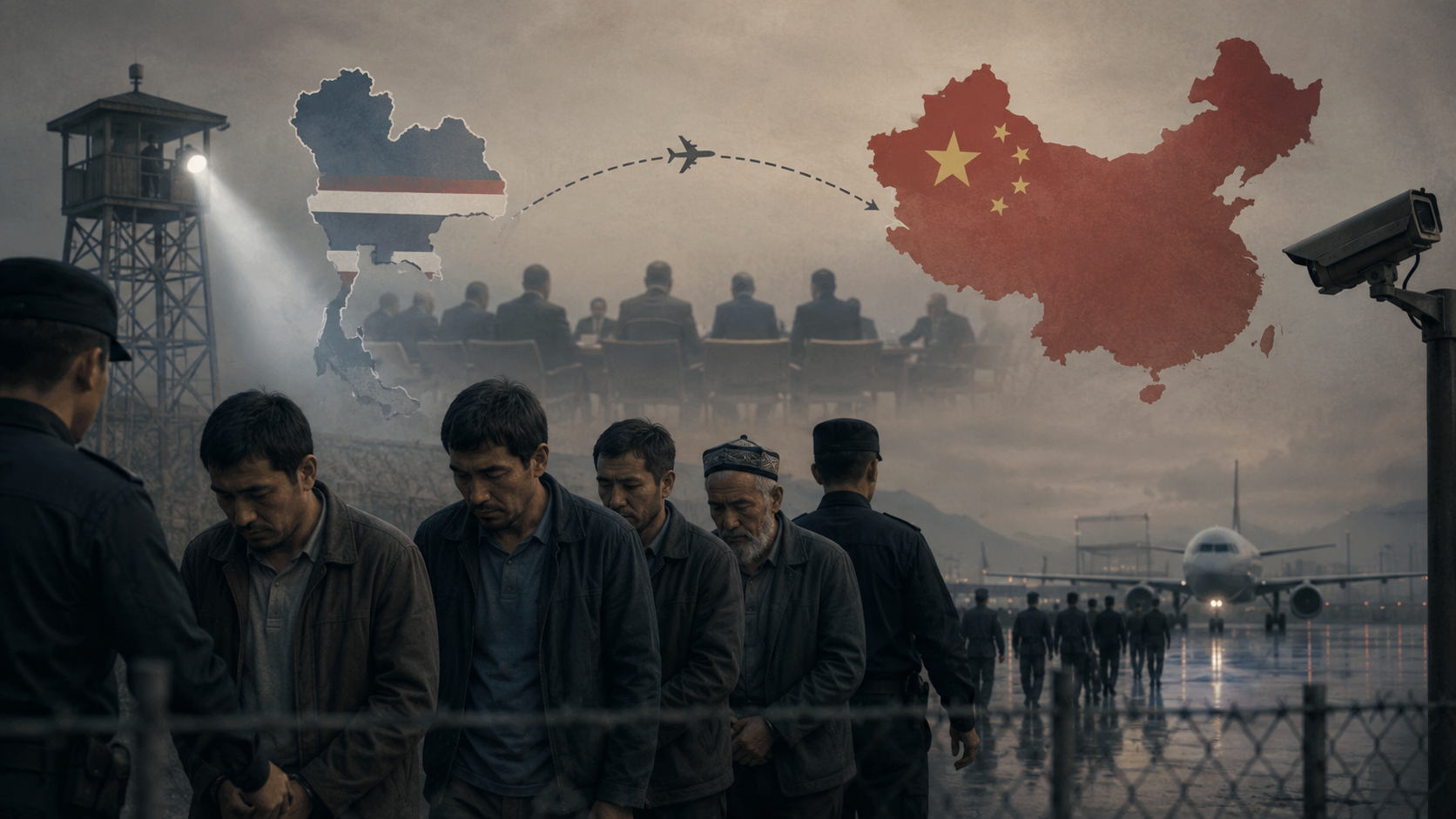
In February 2025, Thailand deported 40 Uyghur Muslims to China after holding them for more than a decade. One year later, UN experts warned that their fate remained unclear.
Who Are the Uyghurs, and Why Were They Fleeing?
The Uyghurs are a mostly Muslim, Turkic-speaking people concentrated in Xinjiang, the region Beijing officially calls the Xinjiang Uyghur Autonomous Region. China’s 2020 census counted about 11.8 million Uyghurs in the country, while Uyghur communities also live across Central Asia, Türkiye, Europe, North America and Australia.
Many Uyghurs have tried to leave China because of fears linked to surveillance, arbitrary detention, religious restrictions, family separation and pressure on their language and culture.
Southeast Asia became one escape route. Around 2014, Thai authorities detained more than 300 Uyghur asylum seekers near the Malaysian border. Many were believed to be trying to reach Malaysia and then Türkiye, which has long attracted Uyghurs because of Turkic and Muslim ties. Some Uyghur women and children from that group were later sent to Türkiye, while many men remained in Thai immigration detention.
Deportation, Pressure and a Warning Ignored
On February 27, 2025, Thailand deported 40 Uyghur men to China despite warnings from UN experts and human-rights groups. Bangkok said it had received assurances from Beijing that the men would be treated well. China described them as Chinese nationals who had entered Thailand illegally.
Rights groups argued Thailand had violated the principle of non-refoulement, which says people should not be returned to a country where they face a real risk of torture, arbitrary detention, enforced disappearance or other serious harm. UN experts had warned Thailand about exactly those risks before the deportation.
China’s determination to recover the men may seem disproportionate. But the issue was never only numerical. Uyghurs fleeing abroad challenge Beijing’s official story that Xinjiang is stable and its policies are accepted. Their escape creates witnesses, diaspora networks and political pressure. Returning them sends a warning that even outside China, vulnerable minorities may not be beyond Beijing’s reach.
A Year Later, Still No Clear Answers
In February 2026, UN experts raised the alarm again. One year after the deportation, they said China’s silence had deepened fears over the men’s condition and whereabouts. Families and rights groups had not received credible proof that the deported men were safe, free and able to communicate.
If China wants the world to believe the men are safe, it should allow transparent access to families, lawyers or independent observers. Instead, the lack of information strengthens fears that they disappeared into a system already accused of severe abuses.
China’s Treatment of Minorities
The broader context is grim. In January 2026, UN experts warned of persistent allegations of state-imposed forced labor involving Uyghurs, Kazakhs, Kyrgyz and Tibetans across China. They said some coercive labor-transfer schemes may amount to forcible transfer or enslavement as a crime against humanity. China rejected the claims as fabricated.
Even without using the language of genocide, the criticism remains severe. China’s policies toward minorities have been accused of suppressing identity, faith, language and dignity under the banners of security, poverty reduction and modernization.
APHR’s Warning and ASEAN’s Official Silence
ASEAN Parliamentarians for Human Rights (APHR) condemned Thailand’s decision in March 2025, calling it a violation of Thailand’s human-rights obligations and warning that the men faced risks of torture, enforced disappearance and other grave abuses after return to China.
APHR also noted that the men had been detained since 2014 after fleeing repression in Xinjiang. It urged ASEAN governments not to bow to China’s political pressure and called for protection of Uyghurs and other vulnerable refugees.
However, the issue does not appear in the public Chair’s Statement of the 48th ASEAN Summit in Cebu in May 2026. ASEAN discussed human rights in general terms and addressed Myanmar at length, yet its official summit statement stayed silent on the 40 Uyghur men deported by Thailand.
As the world’s largest Muslim-majority country, Indonesia should support transparency, oppose forced returns, call for independent access and defend the principle that Uyghurs should not be sent back into danger. Muslim solidarity should include Uyghur Muslims. Human dignity should include minorities living under Chinese rule.
About the Author



2 thoughts on “The Forgotten Forty: Uyghur Muslims and ASEAN’s Silence”
Comments are closed.