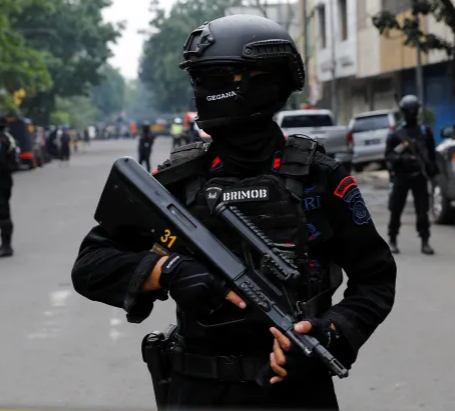
Indonesian police
A string of recent cases in Bali is raising a tough question: is there an increasing trend of crime events involving foreigners in Indonesia, or are we simply seeing more of what was already there?
In a short span, police handled a fatal stabbing involving Europeans and South Americans, a confirmed kidnapping and murder case tied to foreign suspects, and the arrest of a British fugitive linked to global financial crime. The cases are different, but they point to the same reality: Bali is no longer just a tourist island… it is part of a much wider international network.
The Dutch man killed by two Brazilians
On March 23, 2026, a 49-year-old Dutch national (RP) was stabbed to death outside a villa in Kerobokan, North Kuta. The attack happened at around 10 p.m. as he walked with a companion.
Two men on a motorcycle approached and immediately attacked him with a sharp weapon, inflicting multiple wounds to the neck, face, and body. He died at the scene.
Police later identified the suspects as Brazilian nationals Darlan Bruno Lima San Ana, 34, and Kalil Hyorran, 32. CCTV footage and forensic evidence helped track their movements. Both men left Indonesia the next day.
Authorities have requested assistance from Interpol to locate them. The speed and precision of the attack suggest it was planned, not random.
The Ukrainian kidnapping and murder case
The case of Ukrainian national Ihor Komarav, 28, shows a different level of organization. He was reported missing on February 15, 2026, after going out in South Kuta. Soon after, a video surfaced showing him inside a villa, with kidnappers demanding ransom from his family.
The investigation confirmed the worst outcome. DNA tests finalized on March 5 matched body parts found on Ketewel Beach with Komarav at a 99.99 percent probability.
Police have named six foreign nationals as suspects, all men using multiple passports. Authorities say some held two or even three identities. Four suspects have already left Indonesia, while two remain unaccounted for.
Investigators traced the case through CCTV, GPS data, and a rented Toyota Avanza linked to the suspects. Blood evidence was found both in the vehicle and at a villa in Tabanan, believed to be where the ransom video was recorded.
The case points to a coordinated operation involving kidnapping, movement across locations, and attempts to evade identification.
The British Interpol fugitive case
On March 28, 2026, immigration officers arrested a British national (SL), 45, at Ngurah Rai Airport upon arrival from Singapore.
He was flagged by the system due to an active Interpol Red Notice. Authorities believe he is connected to an international network involved in shell companies and money laundering.
He was detained immediately and handed over to police. The arrest highlights how Indonesia’s border controls have become more integrated and responsive to cross-border threats.
Bali as a global hub
Bali’s rapid transformation helps explain why these cases are appearing more often. The island now attracts digital nomads, investors, and remote workers from around the world. Most operate legally, some do not.
Conflicts, financial disputes, and even criminal activity are often imported into Bali rather than created there. As the island becomes more connected, these risks become more visible.
At the same time, enforcement has improved. Immigration systems are tighter, and cooperation with international agencies is stronger. More cases are detected, not necessarily because crime is exploding, but because it is harder to hide.
So, is there an increasing trend of crime events involving foreigners? Not in the sense of a sudden crime wave. But there is clearly a shift: more international actors, more complex cases, and more attention from authorities.
About the Author