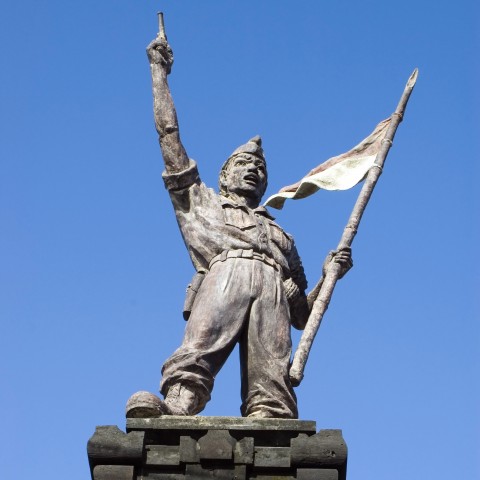
Indonesia marked Heroes’ Day on November 10 with ceremonies, colorful processions and the recognition of 19 new National Heroes. While thousands celebrated the country’s history, student demonstrations and renewed debates over historical recognition showed that the meaning of heroism remains relevant to modern Indonesia.
From Surabaya to celebrations across Indonesia
Heroes’ Day commemorates the Battle of Surabaya on November 10, 1945, when Indonesian fighters resisted a major British-led offensive just months after independence was proclaimed.
Despite their military disadvantages, Indonesian forces fought for weeks, inspired in part by Bung Tomo’s famous radio broadcasts. The battle became a lasting symbol of the nation’s determination to defend its independence.
This year’s official theme, Pahlawanku Teladanku, Melangkah Bersama, Melanjutkan Perjuangan, roughly translates to “My Heroes, My Role Models: Moving Forward Together, Continuing the Struggle.”
The theme encourages Indonesians to carry forward the values of earlier generations through public service, solidarity and contributions to society.
In Surabaya, around 1,000 participants attended commemorations featuring Sang Pekik, a theatrical performance involving 300 local artists.
Semarang hosted an especially striking procession. Approximately 7,000 people joined the Kirab Merah Putih, carrying a 1,945-meter Indonesian flag and 2,026 portraits of national heroes.
At Kalibata Heroes Cemetery in Jakarta, officials honored independence fighters with a ceremony and a minute of silence.
Nineteen new heroes reflect different chapters of Indonesian history
At the State Palace, President Prabowo Subianto conferred National Hero titles on 19 historical figures. The ceremony brought together their families and descendants, representing generations of contributions to Indonesia’s independence and development.
One particularly fitting recipient was Soengkono, who helped organize the resistance during the Battle of Surabaya itself.
Other recipients reflected a broader definition of national service.
Former police chief Hoegeng Imam Santoso became known for his personal integrity and opposition to corruption, while former Jakarta governor Ali Sadikin helped transform the capital during the 1960s and 1970s.
The awards also recognized Indonesia’s intellectual and diplomatic heritage. Writer Sutan Takdir Alisjahbana helped shape modern Indonesian literature, while former prime minister Ali Sastroamidjojo played an important role in organizing the 1955 Bandung Conference.
Among the honorees was Margono Djojohadikusumo, an early independence-era official and founder of Bank Negara Indonesia. He was also President Prabowo’s grandfather.
Together, the recipients represented military resistance, diplomacy, education, public administration and cultural development.
Historical recognition continues to raise questions
National Hero titles can also provoke debate about how Indonesia remembers complicated political legacies.
Former President Suharto, recognized in 2025, remains a subject of disagreement. Supporters highlight economic development and stability during his presidency, while critics cite authoritarian repression, corruption allegations and serious human-rights abuses under his administration.
On November 10, the civil society coalition GEMAS renewed its opposition to Suharto’s designation. A Jakarta court is scheduled to rule on a legal challenge on November 17.
Margono’s family connection to President Prabowo also attracted attention. Culture Minister Fadli Zon said the president’s family had initially opposed the nomination because of concerns about how it might be perceived.
Heroes’ Day also brings demonstrations
Not all Indonesians marked Heroes’ Day through ceremonies and celebrations. In Yogyakarta, students and civil society groups used the anniversary to call for stronger government accountability, action on forest fires, improved wages and protection of civil liberties.
Some demonstrators also demanded the revocation of former President Suharto’s National Hero title, arguing that his political legacy conflicts with the values the designation represents.
Governor Sri Sultan Hamengku Buwono X met protesters to discuss their concerns. Later that evening, separate confrontations near the provincial legislature led to unrest, with police reporting 154 detentions.
The demonstrations reflected another aspect of the commemoration: for some Indonesians, honoring national heroes also means publicly questioning whether the country is upholding the values associated with its independence.
A day of unity in a diverse nation
Heroes’ Day should ultimately be an occasion for unity and national pride, without requiring Indonesians to agree on every political or historical question.
Indonesia’s strength lies partly in its extraordinary diversity: hundreds of ethnic communities, languages and traditions sharing a common national identity.
As a democracy, Southeast Asia’s largest economy and an influential voice in ASEAN, Indonesia has achievements that extend far beyond the independence struggle.
About the Author