
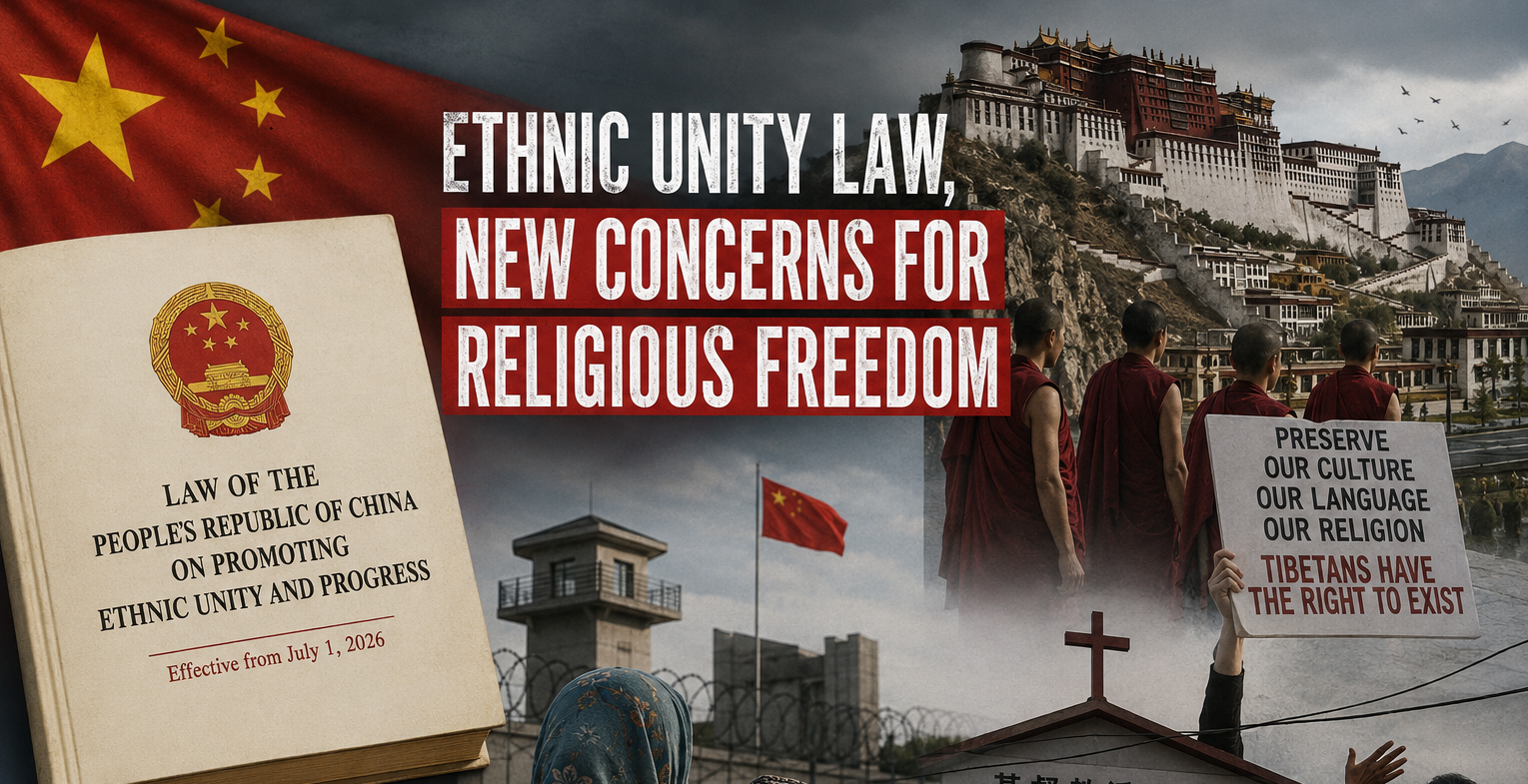
Ethnic Unity Law
China’s new ethnic unity law has added fresh concern to an old question: can minorities in China preserve their religion, language, and culture without being treated as a political threat?
What the Ethnic Unity Law Says
The Law on Promoting Ethnic Unity and Progress was adopted on March 12, 2026, by China’s National People’s Congress and took effect on July 1. Beijing says the law strengthens national unity, protects ethnic groups, and supports development in minority regions. Critics say it gives the state a stronger legal framework for assimilation, especially in Xinjiang, Tibet, and Inner Mongolia.
The ethnic unity law promotes what Chinese officials call “a strong sense of community for the Chinese nation.” It applies to China’s 56 officially recognized ethnic groups, including the Han majority and 55 minority groups.
Its chapters cover shared national belonging, interaction between ethnic groups, integration, and common prosperity. It also says citizens have a duty to uphold national unity and ethnic solidarity. The law prohibits discrimination and suppression against any ethnic group.
Language is one of the most sensitive parts. The law says the state shall promote standard spoken and written Chinese, meaning Mandarin and standard Chinese characters. It also says the right to study and use minority languages should be respected and safeguarded.
But the wording raises an obvious question: does China’s conduct match those ideals?
In Tibet, rights groups have accused China of pushing Mandarin-centered education from early childhood and weakening Tibetan-language learning. In Inner Mongolia, earlier changes to school language policy reduced the role of Mongolian in key subjects and triggered protests. In Xinjiang, Uyghur language, religion, family life, and cultural identity have long faced pressure under the language of fighting extremism and separatism.
U.S. and EU Criticism, China’s Rejection
After the law took effect, the United States and European Union raised concern over its impact on minority rights, religious freedom, language, and cultural identity. One major concern is the law’s possible overseas reach. Chinese officials have indicated that parts of it can apply beyond China’s borders, raising fears among Uyghur, Tibetan, Mongolian, and other diaspora communities.
China rejected the criticism on July 3. Foreign Ministry spokesperson Guo Jiakun said Beijing protects minority cultures and safeguards the right of ethnic groups to use and develop their languages. He accused critics of a “malicious smear,” ideological bias, spreading false information, and interfering in China’s internal affairs.
This exchange shows why the law has become more than a domestic legal issue. For Beijing, it is about unity and sovereignty. For critics, it risks turning minority identity into a security problem.
Amnesty Warns Of Forced Assimilation
Amnesty International warned that the law could entrench assimilation of Uyghurs, Tibetans, Mongolians, and other non-Han communities. Amnesty said the law pushes minorities toward a single, state-defined national identity dominated by Han Chinese culture.
The group also warned that peaceful advocacy may become riskier. Promoting minority languages, documenting abuses, or campaigning for detained people could be framed as undermining ethnic unity.
For Uyghur Muslims, this concern is not theoretical. Xinjiang has already seen mass surveillance, restrictions on religious expression, pressure on Islamic practices, and international accusations of forced assimilation. China denies abuses and says its policies fight terrorism and separatism. But the new law gives critics another reason to fear that religious and cultural difference will face even tighter control.
Tibet Returns To Focus After Lobga Rangzen’s Death
The law also comes as Tibet has returned to international attention.
On July 2, 2026, Tibetan activist Lobga Rangzen set himself on fire near the United Nations headquarters in New York. Activists and exiled Tibetan media identified him as the man involved. He later died from severe burns. Voice of Tibet said he made a live appeal for Tibetan independence and unity before the act.
On July 8, the U.S. State Department said it would continue supporting Tibetans’ right to preserve their culture, language, and religion without fear of interference. It also called on China to return to direct dialogue with the Dalai Lama, his representatives, and elected Tibetan leaders.
China rejects foreign criticism over Tibet and says Tibet has been part of China since ancient times. Beijing also insists it must approve the Dalai Lama’s successor. For many Tibetans, that position itself shows the problem: a state claiming authority over a religious future.
Pastor Ezra Jin And China’s Christians
The same pattern also appears in China’s treatment of independent Christians.
Pastor Jin Mingri, also known as Ezra Jin, was released on July 4 after nearly nine months in detention in Beihai, in Guangxi Province. He is the founder of Zion Church, an independent Protestant church that operated outside China’s state-approved religious system.
Christian Solidarity Worldwide welcomed his release, but noted that other Zion Church members remained detained. His case shows that China’s religious freedom issue is not limited to Muslims or Buddhists. Independent Christian communities also face pressure when they refuse full state control.
The ethnic unity law may speak the language of harmony. But the deeper concern is control. For Uyghur Muslims, Tibetan Buddhists, Mongolians, and underground Christians, the question is whether faith and identity can survive without being reshaped by the state.
About the Author




2 thoughts on “China’s Ethnic Unity Law Raises New Concerns Over Religious Freedom”
Comments are closed.