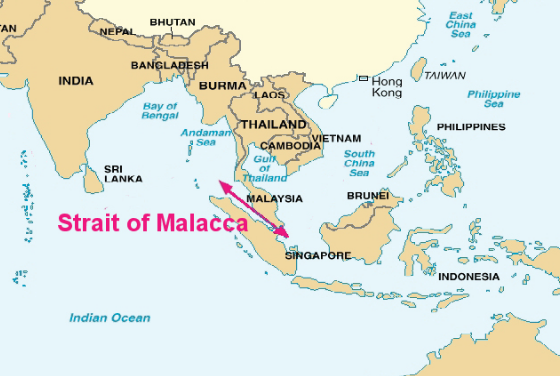
Maritime patrols are becoming more important as tensions in global chokepoints raise new questions about security at sea. If the Strait of Hormuz has shown how disruption can shake the global economy, the Strait of Malacca underscores how much East Asia depends on open sea lanes. With China pressing illegal maritime claims in nearby waters and regional tensions rising, Indonesia’s expanding maritime patrols are increasingly about geopolitical preparedness as much as fighting piracy.
ASEAN Joint Maritime Patrols
Indonesia’s Maritime Security Agency (Bakamla) has intensified operations across its western and central zones, including the Malacca Strait, Aceh, and Natuna waters. These maritime patrols involve coordination between the Indonesian Navy, maritime police, customs, and fisheries authorities, reflecting the scale and complexity of the challenge.
Joint maritime patrols with ASEAN partners are also expanding. Indonesia now works closely with Malaysia, Singapore, the Philippines, and Vietnam through regular coordination and information-sharing frameworks such as the ASEAN Coast Guard Forum. Recent drills in nearby waters, like the military drills in the Singapore Strait, have focused on improving interoperability and rapid response.
Piracy and Security Risks
The primary threat remains piracy and maritime crime. While the era of major ship hijackings in the Strait of Malacca has receded, the threat has not disappeared. Recent reporting from the regional anti-piracy body ReCAAP showed 108 armed robbery incidents in the Straits of Malacca and Singapore in 2025, up sharply from 62 in 2024 and the highest level recorded in the area since 2007. Most were opportunistic nighttime boardings involving theft of engine spares, scrap metal, ship stores, or crew belongings, rather than large-scale seizures, but the spike reinforced concern over security in one of the world’s busiest shipping corridors.
There have also been signs that stronger enforcement works. Incidents in the first quarter of 2026 fell to 10, down from 36 a year earlier, after arrests by Indonesian authorities and intensified patrols in the Singapore Strait.
But the risks are no longer limited to crime. Recent events in the Strait of Hormuz show how quickly a chokepoint can become unstable in times of geopolitical tensions. Since the escalation involving Iran, Brent crude has climbed to around $90 per barrel during peak tension periods, while shipping insurance premiums surged and some vessels rerouted to avoid risk.
Global chokepoints and economic exposure
The Malacca Strait is one of several critical maritime chokepoints, alongside the Strait of Hormuz, Bab el-Mandeb, the Suez Canal, and the Panama Canal. Each plays a central role in global trade, but few are as vital to East Asia as the Malacca Strait.
Around 16–17 million barrels of oil per day pass through the Malacca Strait, along with a significant share of LNG shipments bound for East Asia. Beyond its role in energy security, the strait also carries around a quarter of global seaborne trade, making even limited disruptions economically significant.
Hormuz has repeatedly shown how tensions can disrupt flows. A similar shock in Southeast Asia would likely have broader consequences, given the region’s role in manufacturing and trade.
A shifting geopolitical landscape
The broader strategic environment adds to the uncertainty.
China continues to press expansive “nine-dash line” claims in the South China Sea that were rejected by an international arbitral tribunal in 2016, yet Beijing has largely ignored that ruling. Through coast guard deployments, maritime militia activity, and repeated pressure on neighboring vessels, China has used so-called grey-zone tactics to advance claims many critics regard as incompatible with international law. Repeated confrontations with the Philippines and tensions around Indonesia’s Natuna waters have made clear these are not abstract disputes, but active security challenges.
The Taiwan Strait raises another concern. Beijing’s growing military drills, air and naval incursions, and repeated threats to bring Taiwan under its control by force if necessary have heightened fears that a regional confrontation could spill into surrounding sea lanes.
China also maintains close ties with Iran, while Iran has supplied drones used by Russia in the Ukraine war. That matters because Iran has shown how a regional power can use a chokepoint to pressure the wider world. Tehran has exposed how easily global trade can be held hostage: The economic effects of the blockade of the Strait Hormuz are felt globally through oil prices, freight costs and supply chains.
The warning for Southeast Asia is that maritime pressure can emerge faster than many assume. China’s illegal claims in nearby waters, tensions over Taiwan, and the lesson of Hormuz all point to the same conclusion: strategic chokepoints cannot be treated as permanently secure. For Indonesia and ASEAN, that is precisely why military readiness and maritime cooperation matter.
About the Author