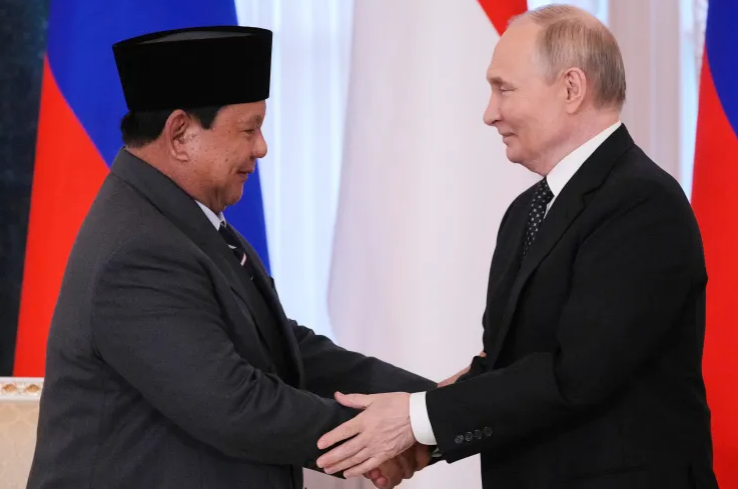
Prabowo Putin Meeting
Indonesia is facing mounting pressure as multiple geopolitical developments converge at once. Jakarta is in talks with Washington over allowing U.S. military aircraft access to Indonesian airspace, while President Prabowo is engaging Russia on defense cooperation. At the same time, the global backdrop is deteriorating: a 40-day Iran–U.S. conflict has entered a fragile ceasefire, talks in Islamabad have failed, and the Strait of Hormuz remains effectively closed by Iran, with Washington preparing a potential blockade of Iranian ports. In this context, Indonesia’s neutrality is being tested in real time.
Indonesian Airspace Talks and Strategic Implications
The proposed U.S.–Indonesia airspace arrangement, currently under a non-binding “Letter of Intent,” goes beyond routine cooperation. Washington is seeking expanded access, including overnight overflight rights for military aircraft. President Prabowo Subianto has approved the proposal. Indonesia’s defense ministry clarified that discussions are ongoing and no final decision has been made.
Indonesia’s geography makes this proposal strategically significant. Positioned between the Indian and Pacific Oceans and near key chokepoints like the Malacca and Lombok Straits, Indonesia plays a central role in global military logistics. Allowing U.S. overflight would improve rapid deployment between the Middle East and the Indo-Pacific, making this less about aviation and more about strategic alignment.
Prabowo’s Russia Outreach and the Sanctions Question
On April 13, Prabowo met Russian President Vladimir Putin in Russia, with defense cooperation high on the agenda. Discussions included potential arms deals, military training, and broader security ties.
This engagement comes with clear risks: Russia remains heavily sanctioned following its 2022 invasion of Ukraine and continues to face economic and technological constraints. Any Indonesian purchase of Russian weapons could trigger penalties under the U.S. Countering America’s Adversaries Through Sanctions Act (CAATSA), which targets countries engaging in significant defense transactions with Moscow.
This is risky business: Russia offers military hardware, but at the cost of exposure to sanctions and reduced access to Western systems.
China, Iran, and a Growing Security Axis
Adding to the uncertainty are intelligence reports that China may be preparing to supply Iran with air defense systems, including portable missile platforms known as MANPADS.
Such a move would strengthen Iran’s defensive capabilities at a time of heightened tension and signal deeper coordination between Beijing and Tehran. It also aligns with China’s broader posture, from pressure in the South China Sea to rising tensions around Taiwan.
This also reflects a broader pattern of cooperation among authoritarian powers.
Indonesia’s Neutrality in a Divided World
Indonesia has long pursued an “independent and active” foreign policy, but Indonesia’s neutrality is becoming harder to sustain. The global system is increasingly defined by two opposing blocs: on one side are democratic states, led by the United States and its allies. On the other are Iran, Russia, and China: authoritarian powers that drive instability through conflict, coercion, and disruption of critical global routes.
At the regional level, Southeast Asia is also shifting. The Philippines has strengthened defense ties with the United States, expanding access for American forces. Other ASEAN members remain cautious, creating a more fragmented regional landscape.
About the Author