
Prabowo's US Visit
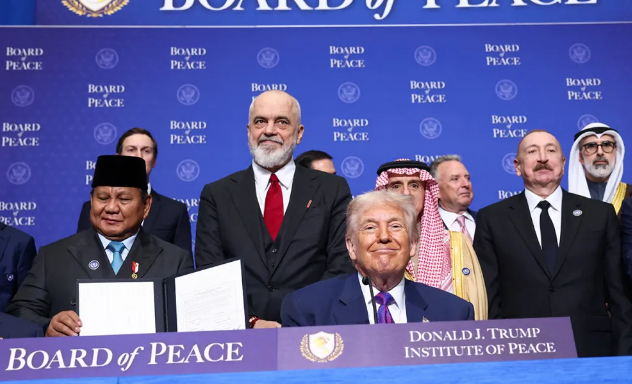
Prabowo’s US visit this week placed Indonesia at the intersection of peace diplomacy and hard trade negotiations. The Indonesian president traveled to Washington from February 16 to 21, 2026, attending the inaugural Board of Peace Summit on February 19 and holding a bilateral meeting with U.S. President Donald Trump that produced a new tariff agreement.
The Board of Peace and Indonesia’s 8,000 Troop Commitment
At the U.S. Institute of Peace, Prabowo joined leaders from Bahrain, Kazakhstan, Uzbekistan and several Middle Eastern states for the first Board of Peace Summit focused on Gaza stabilization.
During the summit, Prabowo stated that Indonesia is prepared to contribute 8,000 or more troops to an international security force for Gaza. The pledge placed Indonesia among the most concrete contributors to the initiative, alongside major financial commitments from Gulf states.
Global Tariffs and the Supreme Court Ruling
Global trade tensions remain high after years of Chinese dumping, heavy state subsidies, forced technology transfers and currency policies that Washington argues distorted markets and triggered the current trade war.
As Jakarta and Washington finalized their discussions, the U.S. Supreme Court ruled that President Trump had exceeded his authority in imposing sweeping global tariffs under emergency powers. Trump responded by announcing a blanket 15 percent levy on imports while insisting that negotiated agreements with partners would remain valid.
The ruling forced a shift in legal strategy but did not signal a retreat from tariff pressure. The administration’s position remains that corrective trade measures are necessary after prolonged market distortions linked to Beijing’s policies.
The Economic Dimension of Prabowo’s US Visit
After months of negotiation, Indonesia secured a 19 percent reciprocal tariff rate on exports to the United States, reduced from a previously threatened 32 percent. The agreement was formalized during meetings in Washington and accompanied by a reported $38.4 billion trade and investment commitment across sectors.
The Supreme Court decision reshaped the legal framework for tariffs, but it did not void existing negotiated arrangements. Trump’s pivot to a 15 percent global levy establishes a new baseline while preserving country-specific agreements reached through bilateral talks.
For Washington, the broader trade confrontation stems from long-standing concerns about Chinese industrial subsidies, dumping practices and currency management that officials argue undermined fair competition. Tariffs are presented as a response to those structural imbalances rather than an isolated policy choice.
Prabowo said Jakarta respects U.S. domestic politics and is ready for “any eventuality.” Coordinating Minister for Economic Affairs Airlangga Hartarto noted that countries with signed agreements may receive different treatment as U.S. policy evolves. Indonesian negotiators are now focused on protecting zero-tariff treatment for key exports such as palm oil, coffee, cocoa and electronics through separate legal channels.
The visit combined symbolism and calculation. Participation in the Board of Peace raised Indonesia’s diplomatic profile, while tariff talks reduced immediate exposure in a shifting legal environment. Jakarta appears determined to remain pragmatic as global trade tensions continue to unfold.
About the Author

1 thought on “Prabowo’s US Visit: Board of Peace and Tariff Talks”
Comments are closed.