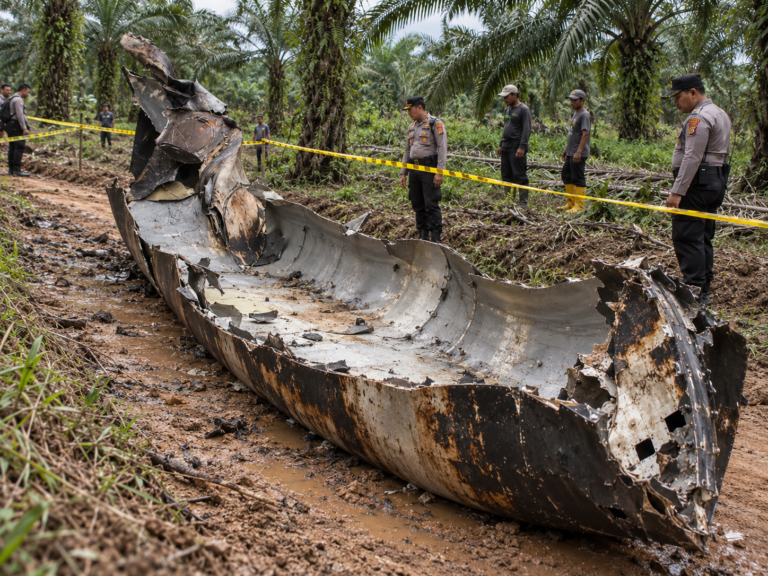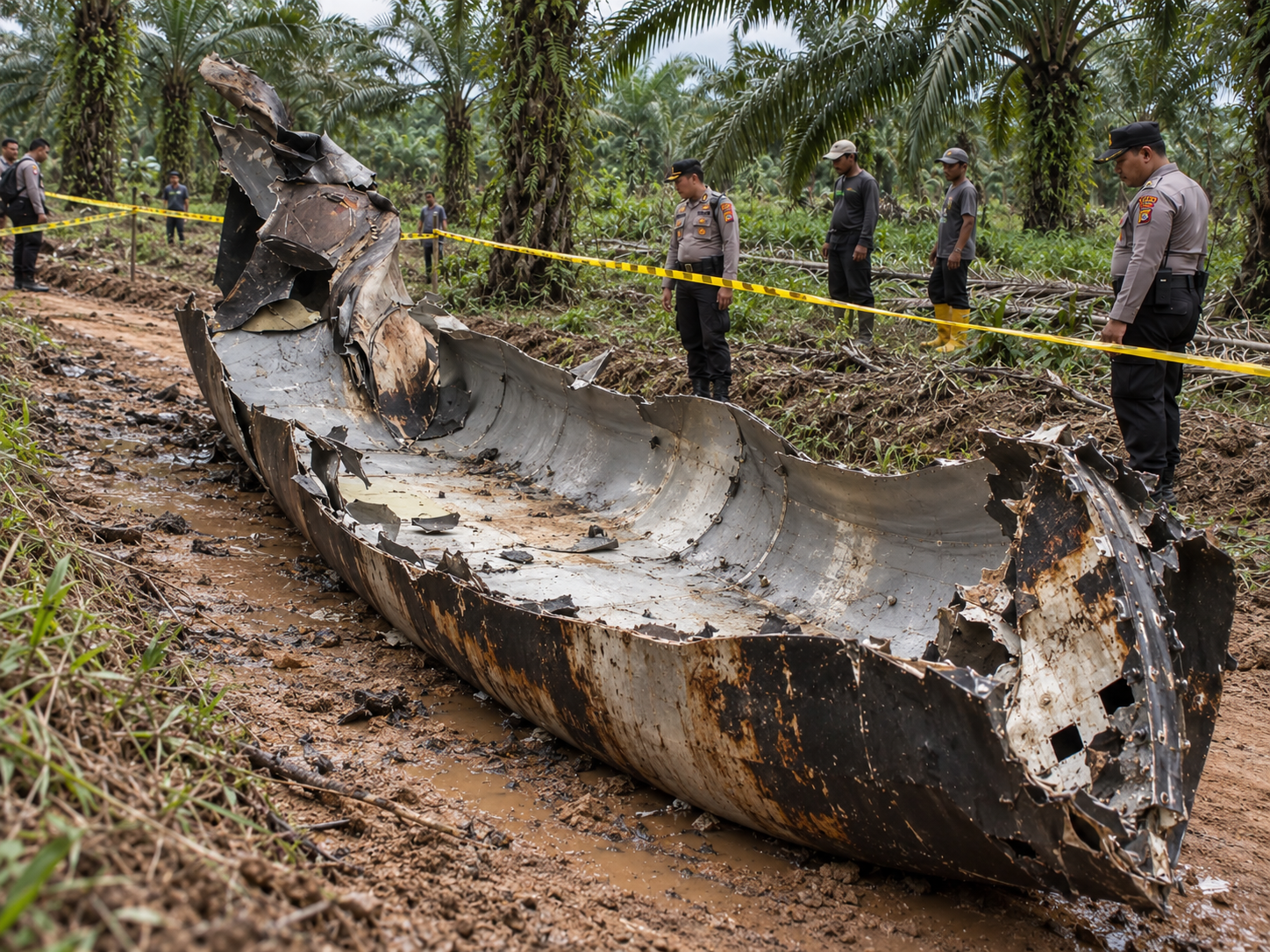
A large piece of suspected Chinese rocket debris discovered in a palm oil plantation in Central Kalimantan has raised questions about the risks of space launches and the responsibilities of countries operating rockets.
The object was found near Sampit on October 19, 2026, after residents heard a loud rumbling noise the previous day. Indonesia’s National Research and Innovation Agency (BRIN) traced its likely origin to a ZhuQue-2E rocket developed by Chinese aerospace company LandSpace. No injuries were reported.
LandSpace had launched ten experimental communications and computing satellites on October 14. However, the precise identification of the recovered debris remains preliminary.
The incident raises a broader question: as space launches multiply, who protects people in countries where discarded rocket components fall?
Why China is launching rockets into space
China’s space program serves scientific, commercial and strategic purposes. Satellites support telecommunications, internet connectivity, weather forecasting, environmental monitoring and navigation through China’s BeiDou system. Others test emerging technologies or conduct scientific research.
Space infrastructure also has military applications, including secure communications, reconnaissance, surveillance and navigation. Many satellite technologies serve both civilian and military purposes.
China’s growing commercial space industry, including companies such as LandSpace, also supports its technological independence and international competitiveness.
Why rocket debris falls back to Earth
Rockets discard components during flight, but falling debris does not always follow the same pattern.
Planned rocket-stage separation occurs when boosters or protective fairings detach during launch. Operators can calculate approximate landing zones, often over the ocean, and warn ships and aircraft.
Uncontrolled reentry occurs when a spent rocket stage remains in orbit. Atmospheric drag eventually brings it back toward Earth, sometimes months or years later. Its precise landing location may remain uncertain until shortly before reentry.
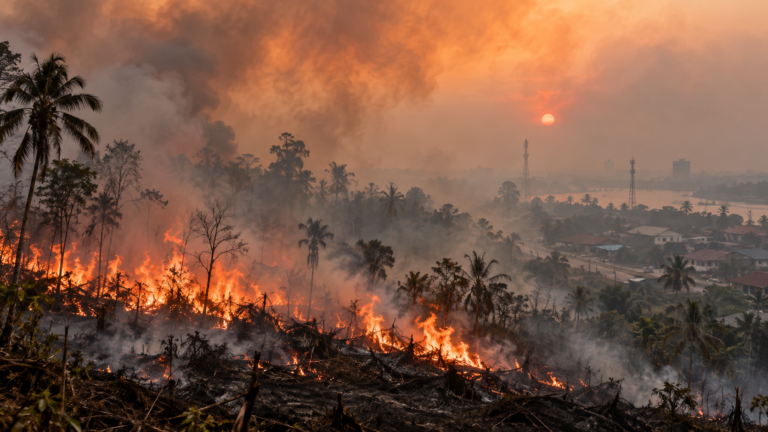
Much of the material burns up in the atmosphere, but heavy or heat-resistant components can survive.
Controlled reentry offers a safer alternative, allowing operators to direct debris toward remote ocean areas.
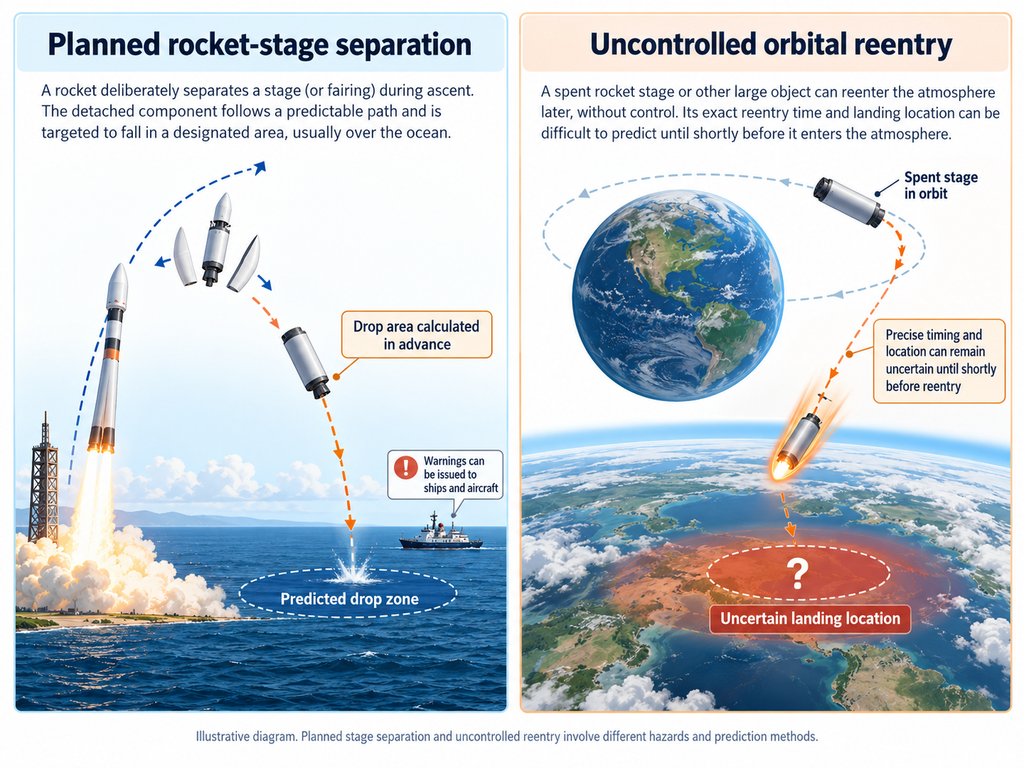
Planned rocket-stage separation vs. uncontrolled orbital reentry.
How dangerous is falling rocket debris?
A 2022 study published in Nature Astronomy examined more than 1,500 rocket bodies that returned to Earth between 1992 and 2022. Researchers estimated that over 70% had reentered uncontrolled.
They calculated approximately a 10% chance of at least one casualty worldwide over a decade if historical practices continued.
This is a cumulative global estimate, not the probability of injury from an individual launch. Confirmed casualties remain extremely rare, although debris has damaged property.
Why the Global South faces greater risks
The study found that populations in the Global South face disproportionate exposure because of the orbital paths followed by many rocket bodies.
Under one estimate, cities including Jakarta, Dhaka, Bogotá and Lagos were at least three times as likely to experience rocket-body reentries overhead as Washington, Beijing and Moscow.
This does not mean individual residents face three times the probability of injury. Rather, it highlights how countries with limited involvement in space launches can bear risks created by major space powers.
China’s controversial history of rocket debris
China has faced international criticism over its handling of large rocket stages, particularly its Long March 5B missions.
In May 2020, an approximately 18-ton rocket stage made an uncontrolled reentry. Debris struck villages in Côte d’Ivoire, damaging buildings.
Another large Long March 5B stage returned uncontrolled in 2021, landing in the Indian Ocean. In July 2022, a further reentry brought debris over Southeast Asia, with fragments recovered in Indonesia and Malaysia.
China has also faced criticism over transparency
In July 2022, NASA Administrator Bill Nelson accused Beijing of failing to share sufficiently specific trajectory information during a Long March 5B reentry. Such information helps other countries assess potential dangers.
China rejected the criticism, maintaining that it monitored the rocket and released orbital information while accusing American officials of double standards.
Nevertheless, the repeated uncontrolled reentries of large rocket stages have raised legitimate questions about whether safer designs and disposal methods could have reduced the risks.
Repeated warnings in Philippine waters
The Philippines has also experienced recurring concerns about Chinese launches.
On September 23, 2026, the Philippine Space Agency identified two expected debris zones from a Chinese Long March 8A launch. One lay within the Philippine exclusive economic zone, while the other was inside Philippine archipelagic waters.
China had disclosed the zones through an aviation notice, allowing Philippine authorities to issue warnings.
Unlike uncontrolled orbital reentries, these were planned debris-drop areas. Nevertheless, they posed potential hazards to fishing vessels, ships and aircraft.
How does China compare with other countries?
China is not the only country whose space activities have produced dangerous debris.
In 2016, components from an American SpaceX rocket reached Indonesia. In 2022, SpaceX-related spacecraft debris was recovered from farmland in Australia.
In March 2024, equipment discarded from the International Space Station survived reentry and struck a house in Florida.
Space agencies differ in their safety requirements
The European Space Agency requires its missions to keep the calculated casualty risk of reentry below one in 10,000. Missions exceeding that limit must use safer disposal measures, including controlled reentry.
The United States also maintains orbital-debris mitigation standards, although requirements and exemptions vary.
These standards provide a benchmark for evaluating China’s conduct. The issue is not whether China alone produces space debris, but whether operators take reasonable steps to prevent avoidable risks.
Who is responsible when debris falls in another country?
Under the 1972 Convention on International Liability for Damage Caused by Space Objects, a launching state bears absolute liability for damage caused by its space objects on Earth’s surface or to aircraft in flight. This responsibility can apply even when a private company operates the rocket. However, compensation generally requires identifiable damage. Discovering debris without injuries or property damage does not automatically establish a claim.
International guidelines encourage debris mitigation, but no comprehensive global treaty requires every rocket stage to undergo controlled reentry.
For Indonesia, the latest incident leaves important questions unanswered. Did China or LandSpace provide advance warning? Could the rocket stage have been disposed of more safely?
About the Author