Walk of Peace
Vesak Day in Indonesia is more than a Buddhist holy day. As Buddhists mark Waisak 2570 BE on May 31, the celebration brings together prayer, pilgrimage, cultural heritage, local tourism, and a quieter message about second chances.
A Rare Holiday Sequence in Indonesia
Vesak, known in Indonesia as Waisak, commemorates the birth, enlightenment, and death of the Buddha. In Indonesia, its most visible national center is Central Java, where Borobudur, Mendut, and Pawon temples help turn the holy day into both a spiritual gathering and a cultural moment.
The timing is unusual. This year, Waisak comes only days after Eid al-Adha and one day before Pancasila Day. That does not happen every year: Waisak follows the Buddhist lunar calendar, while Pancasila Day is fixed on June 1. But in 2026, the calendar itself gives Indonesia a useful reminder that public holidays can carry spiritual, civic, and social meaning at the same time.
From Bali to Borobudur, a Walk for Peace
This year’s commemoration carried the theme “Dharma: Maintaining World Peace.” That message was not kept inside temples alone.
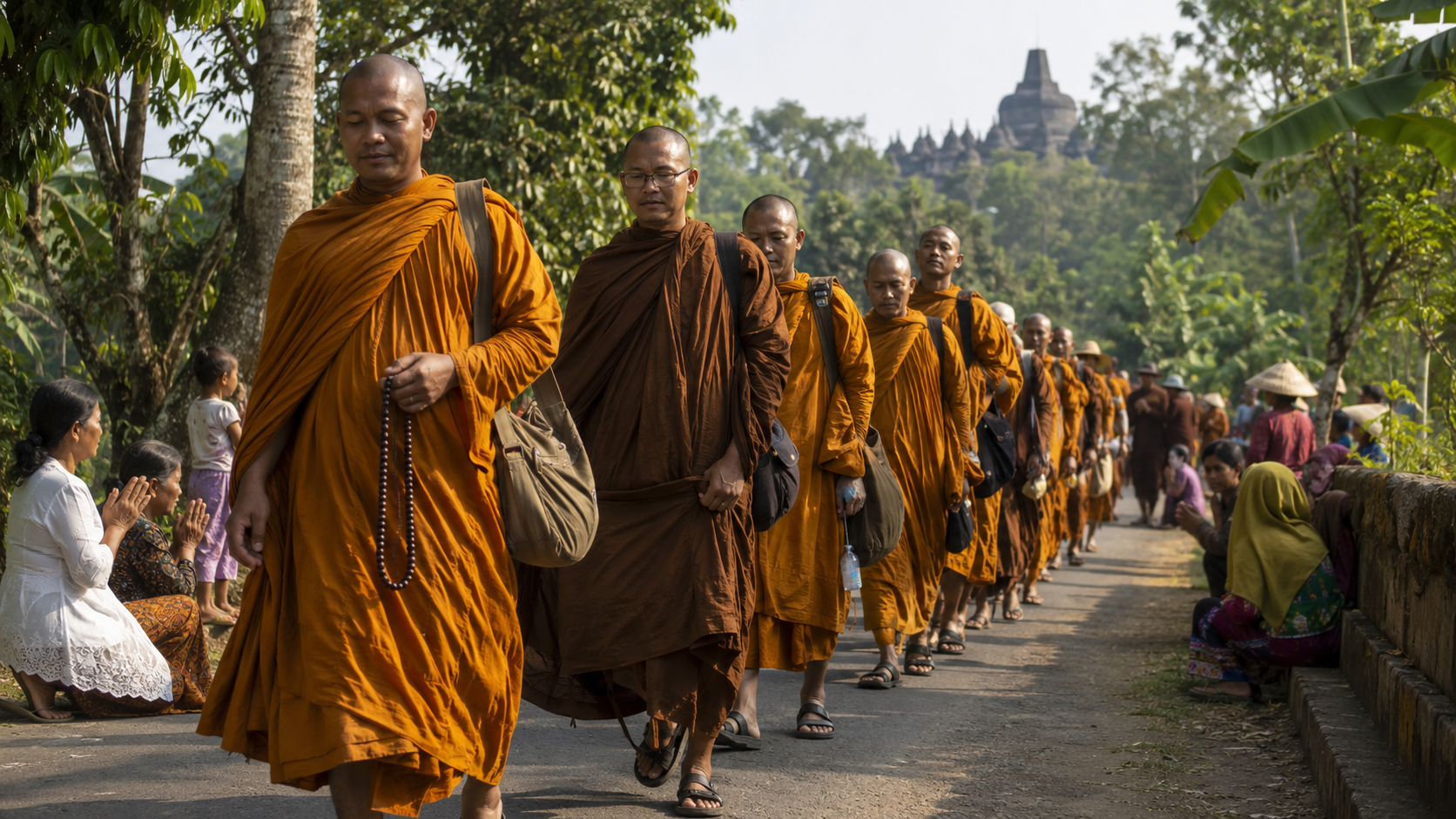
Ahead of Vesak, dozens of monks joined the Indonesia Walk for Peace, traveling hundreds of kilometers from Bali toward Borobudur. Participants came from Indonesia and neighboring Buddhist communities, including Thailand, Malaysia, Laos, and Myanmar. Their journey passed through towns, roads, monasteries, Chinese temples, and even mosques.
The walk was not only religious devotion. It was a public act of calm in a noisy age. In a region often pulled by identity politics, social tension, and online anger, the sight of monks walking patiently through Indonesian streets offered a different kind of message: peace requires discipline, not just slogans.
Vesak Day in Indonesia Also Supports Local Life
The celebrations around Mendut and Borobudur also bring practical benefits. Tens of thousands of Buddhists from across Indonesia were expected to join the sacred events at Borobudur. Hotels, homestays, restaurants, coffee shops, guides, small traders, and local creative businesses all benefit when pilgrims and visitors arrive.
That economic side should not reduce the sacredness of Vesak. It simply shows how religious heritage can support local communities when managed with care. Borobudur is not only a tourist site. It is a living religious and cultural landmark, and that makes preservation essential.
Faith-based tourism works best when it respects worship first and commerce second. If local people benefit while the holy character of the event remains protected, Vesak becomes an example of how culture, economy, and devotion can support one another.
Remissions Add a Message of Second Chances
The government also granted special remissions and sentence reductions to 1,052 Buddhist inmates and juvenile inmates for Vesak. Most received partial sentence reductions, while six inmates were immediately released. Five juvenile inmates also received special sentence reductions.
The Ministry of Immigration and Correctional Affairs framed the decision as recognition for inmates who showed positive behavioral change and joined correctional programs. North Sumatra recorded the largest number of recipients, followed by West Kalimantan and Jakarta.
This fits the moral language of Vesak: self-reflection, restraint, improvement, and renewal. A justice system should punish wrongdoing, but it should also leave room for rehabilitation when people show genuine change.
Religious Affairs Minister Nasaruddin Umar called Vesak a moment to strengthen kindness, unity, and world peace. He also said the state has a constitutional duty to ensure every citizen can practice faith safely and with dignity.
That principle reaches beyond Buddhists. Vesak Day in Indonesia reminds the country that peace is built in many places: in temples, in homes, in prisons, in local economies, and in the daily habits of citizens.
About the Author