India US Trade Deal
The India-US trade deal illustrates how trade policy, energy security, and geopolitics are now tightly linked.
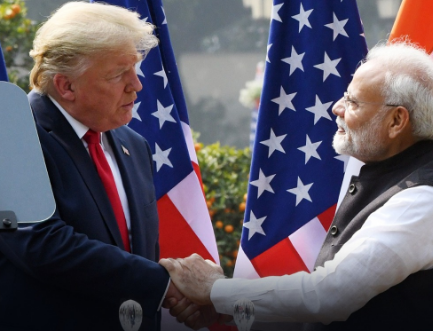
Under the agreement, U.S. tariffs on Indian goods will fall sharply to 18% from 50%. In exchange, New Delhi agreed to halt purchases of Russian oil, shifting toward American and potentially Venezuelan supplies.
The political message is straightforward: access to stable markets is now tied to strategic choices. Indonesia cannot afford to ignore this shift as Indo-Pacific tensions continue to grow.
Two Emerging Blocs and the Role of Sanctions
In the emerging global order, two loose blocs are taking shape. On one side stands a Western-led system built around sanctions, financial rules, and security partnerships; on the other is CRINK (China, Russia, Iran, and North Korea), a loose convergence shaped less by ideology than by shared resistance to Western pressure and sanctions.
Participation in sanctions has become a practical dividing line. Countries aligned with the West have imposed sweeping restrictions on Russia and Iran, while others have avoided formal measures, even as they quietly comply with parts of the global financial system to limit exposure.
India and Indonesia as Hedging Powers
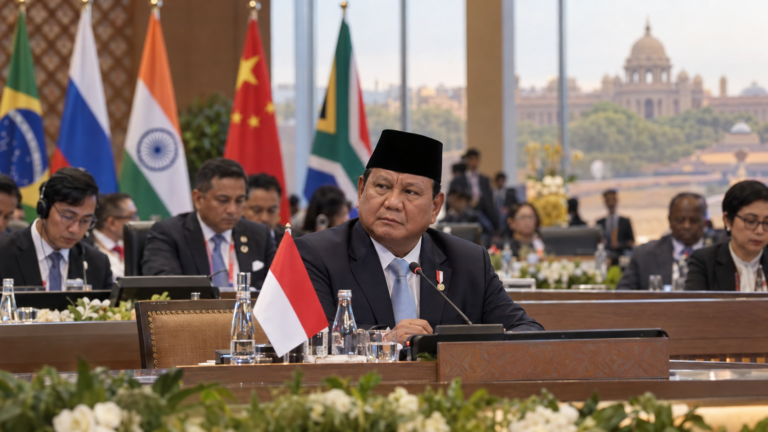
Within this landscape, India and Indonesia have acted as hedging powers rather than firm allies of either bloc. Neither joined sanctions against Russia or Iran, and both framed their approach as strategic autonomy. The difference is that India faced a direct trade-off: continued access to Russian oil versus restored access to the U.S. market, and it chose alignment when neutrality became costly.
Indonesia has not yet faced such a dilemma. Its oil imports are already largely sourced from the Middle East and the United States, not from Russia, allowing Jakarta to avoid a similar choice for now. But as trade, energy, and security become more tightly linked, Indonesia may also be forced to lean more clearly toward one system than the other. As a democracy, it would make more sense for Indonesia to ultimately align with democratic partners than with authoritarian systems.
India-US Trade Deal as a Geopolitical Transaction
For months, Washington had used tariffs to pressure India over its continued imports of discounted Russian crude. India, the world’s third-largest oil importer, had relied heavily on Russian supplies since the invasion of Ukraine in 2022 to manage import costs and inflation.
In that sense, the India-US trade deal marks a turning point. India accepted higher short-term energy costs in exchange for tariff relief, market stability, and deeper integration with the U.S. economy.
Indo-Pacific Security and the South China Sea
Although the Russia–Ukraine war provided the immediate backdrop, the broader driver lies in the Indo-Pacific. For Washington, long-term strategic competition is centered on Asia, not Europe. China’s sweeping claims over much of the South China Sea overlap directly with the interests of several Southeast Asian states. Maritime security and the integrity of regional sea lanes shape U.S. priorities far more than Russian influence in Asia, which remains limited.
This matters directly for Indonesia. The country sits astride some of the world’s most important maritime chokepoints, and its economy depends on predictable shipping routes. Tensions in the South China Sea therefore carry real economic consequences, not just diplomatic ones.
About the Author