
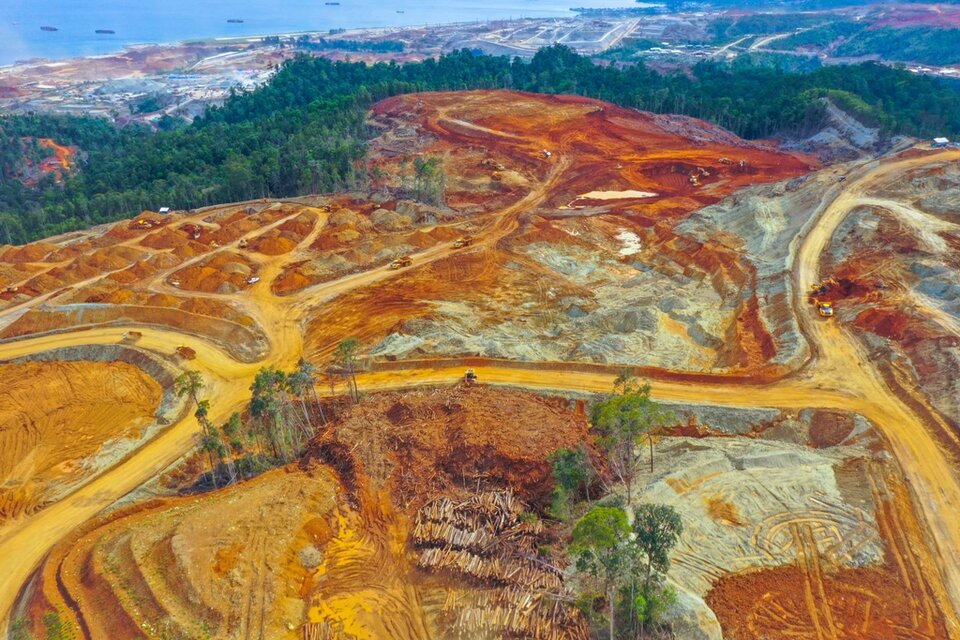
Indonesia’s effort to rein in its fast-growing nickel industry has pushed illegal nickel mining back into the spotlight, exposing weak enforcement, mounting environmental damage, and a growing dependence on China-centred supply chains. After last year’s permit suspensions and land seizures put foreign influence and regulatory failures into focus, the latest crackdowns suggest Jakarta is still struggling to assert control over a sector shaped as much by external demand as by domestic policy.
Over the past year, authorities have moved against mining operations that failed to meet basic regulatory and environmental requirements. In several cases, companies held mining licences but lacked forestry permits or exceeded approved quotas. Activity continued until inspections or public pressure forced intervention. These were not isolated mistakes. They exposed how routine non-compliance had become across parts of the sector.
Illegal Nickel Mining and Weak Enforcement
Crackdowns on illegal nickel mining show that the problem often operates in plain sight. It is not limited to small, informal pits. Large projects have also crossed into illegality through missing permits, delayed approvals, or extraction that pushed beyond what regulators allowed.
This mirrors the wave of permit suspensions imposed last year, when nearly 190 mineral and coal operators were ordered to halt operations for failing to carry out post-mining reclamation or for producing beyond quotas. Officials described the move as a warning that environmental rules would finally be enforced. In practice, it revealed how long those rules had been treated as negotiable.
In nickel-producing regions, enforcement has remained uneven. Oversight has struggled to keep pace with expansion, and monitoring systems have lagged behind conditions on the ground. Once operations are underway, shutting them down becomes politically sensitive and economically costly.
Environmental Damage Forces a Political Reckoning
The environmental impact linked to illegal nickel mining is now harder to dismiss. In eastern Indonesia, mining activity has been associated with forest loss, sediment runoff, and damage to coastal and marine ecosystems. In Raja Ampat, public outrage over mining near fragile reefs forced the government to revoke permits and halt operations.
For nearby communities, the consequences are immediate. Rivers turn cloudy, fish stocks decline, and farmland loses productivity. Cleanup is slow and expensive. Penalties rarely reflect the long-term damage caused. The contradiction is increasingly obvious: nickel is promoted as a cornerstone of the green transition, yet its extraction is degrading some of Indonesia’s most sensitive environments.
China, Nickel, and an Uncomfortable Dependency
Indonesia’s nickel boom has been shaped by demand from China and by downstream processing dominated by Chinese firms. Much of the country’s smelting capacity is tied to Chinese investment and offtake. That concentration carries consequences.
When supply chains depend heavily on a single external market, enforcement tends to bend. The need to keep smelters running has repeatedly pushed mining into grey areas, where permits lag behind operations and oversight becomes an afterthought. In this setting, illegal nickel mining is not an anomaly but a by-product of pressure.
Earlier cases involving Chinese nationals and China-linked projects showed how foreign demand, local intermediaries, and weak supervision can combine to undermine regulations. Nickel follows the same pattern. Indonesia banned raw ore exports to build domestic value, yet the processing backbone remains heavily China-oriented. That dependence limits Jakarta’s room to act decisively when enforcement threatens supply continuity.
Over-reliance on a single dominant buyer makes regulation more fragile and politically charged.
A Narrow Path Ahead
Indonesia’s campaign against illegal nickel mining is ultimately a test of control. Stronger enforcement, clearer permits, and credible environmental monitoring are essential. So is reducing structural dependence that turns regulation into a balancing act.
If Jakarta succeeds, nickel can still support long-term development. If it fails, environmental damage and weakened sovereignty will remain the hidden costs of the boom.
About the Author




1 thought on “Illegal Nickel Mining Exposes Indonesia’s Risky Dependence on China”
Comments are closed.