
The US–Indonesia trade deal is moving from negotiation into execution, at a moment when global trade rules are under strain and geopolitical risk increasingly shapes economic policy. For Jakarta, the agreement with Washington is not just about tariff relief. It reflects a broader effort to reduce exposure to systemic shocks, many of which are linked to unresolved distortions in China-centered global trade.
According to Indonesian and U.S. officials, the agreement could be signed as early as next month, following final technical discussions. Business leaders say the deal could eventually expand bilateral trade up to four-fold from current levels of roughly $40 billion annually. Crucially, it would also revise Indonesia’s tariff status under President Donald Trump’s trade framework. A threatened 32% tariff on Indonesian exports would drop to around 19%, easing pressure on sectors such as palm oil, garments, electronics, and furniture.
For Washington, the logic is balance. Indonesia has run a consistent trade surplus with the United States, and the deal opens greater access for American wheat, cotton, energy, and dairy. For Jakarta, the payoff is stability: preferential access to its largest export market and a clearer legal framework at a time when trade uncertainty has become the norm.
US–Indonesia Trade Deal and the China Factor
The US–Indonesia trade deal also fits into a wider recalibration underway across Asia. While not framed explicitly as decoupling, the agreement helps Indonesia diversify away from excessive reliance on China as a dominant trade partner. That matters as global supply chains grow more politicised and trade policy increasingly intersects with security concerns.
That matters because scrutiny of Beijing’s trade practices has sharpened again in recent months, not faded. Governments and companies are paying closer attention to how China’s industrial overcapacity spills into global markets, often through subsidised exports priced below cost. This has become harder to ignore as pressure builds across sectors from manufacturing to clean energy.
At the same time, China’s increasing use of export controls (particularly on rare earths) has unsettled supply chains far beyond the United States. Executives at the World Economic Forum in Davos spoke openly about the risks of relying too heavily on any single supplier for critical materials, a concern that now shapes trade policy as much as price or volume. For Washington, this reinforces the view that tariffs are not just bargaining tools but a way to hedge against structural exposure.
Indonesia’s position looks different by comparison. Rather than absorbing the shockwaves of the U.S.–China standoff, Jakarta is adjusting around it. By committing to clearer market access rules and reducing non-tariff barriers, Indonesia presents itself as a predictable alternative at a time when predictability is scarce. The US–Indonesia trade deal fits that logic: diversification without disruption, and integration without dependency.
Davos Context: Trade and Diplomacy Intersect
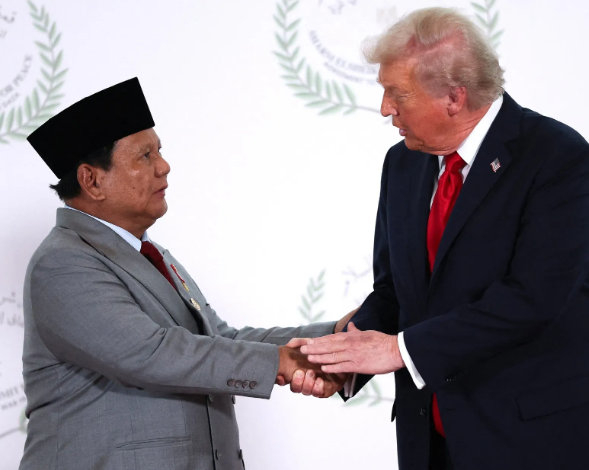
This economic repositioning unfolded alongside a highly politicised World Economic Forum, where Trump dominated discussions on tariffs, security, and geopolitical risk. Indonesian President Prabowo Subianto attended the summit as Jakarta finalised trade talks and expanded its diplomatic footprint.
On the sidelines of the forum, Prabowo joined the launch of the Gaza Board of Peace, an initiative backed by Trump and several Arab and Muslim-majority states. The move reinforced Indonesia’s broader strategy: remain economically pragmatic while playing a visible, stabilising role in global diplomacy.
The message from Davos was consistent. In a world of tariffs, export controls, and political risk, countries that offer clarity gain leverage. Indonesia’s progress with Washington reflects that reality. The global trade war is far from over, but Jakarta is no longer waiting for it to end before adapting.
About the Author



1 thought on “US–Indonesia Trade Deal Takes Shape as Jakarta Repositions in a Fragmented Global Economy”
Comments are closed.